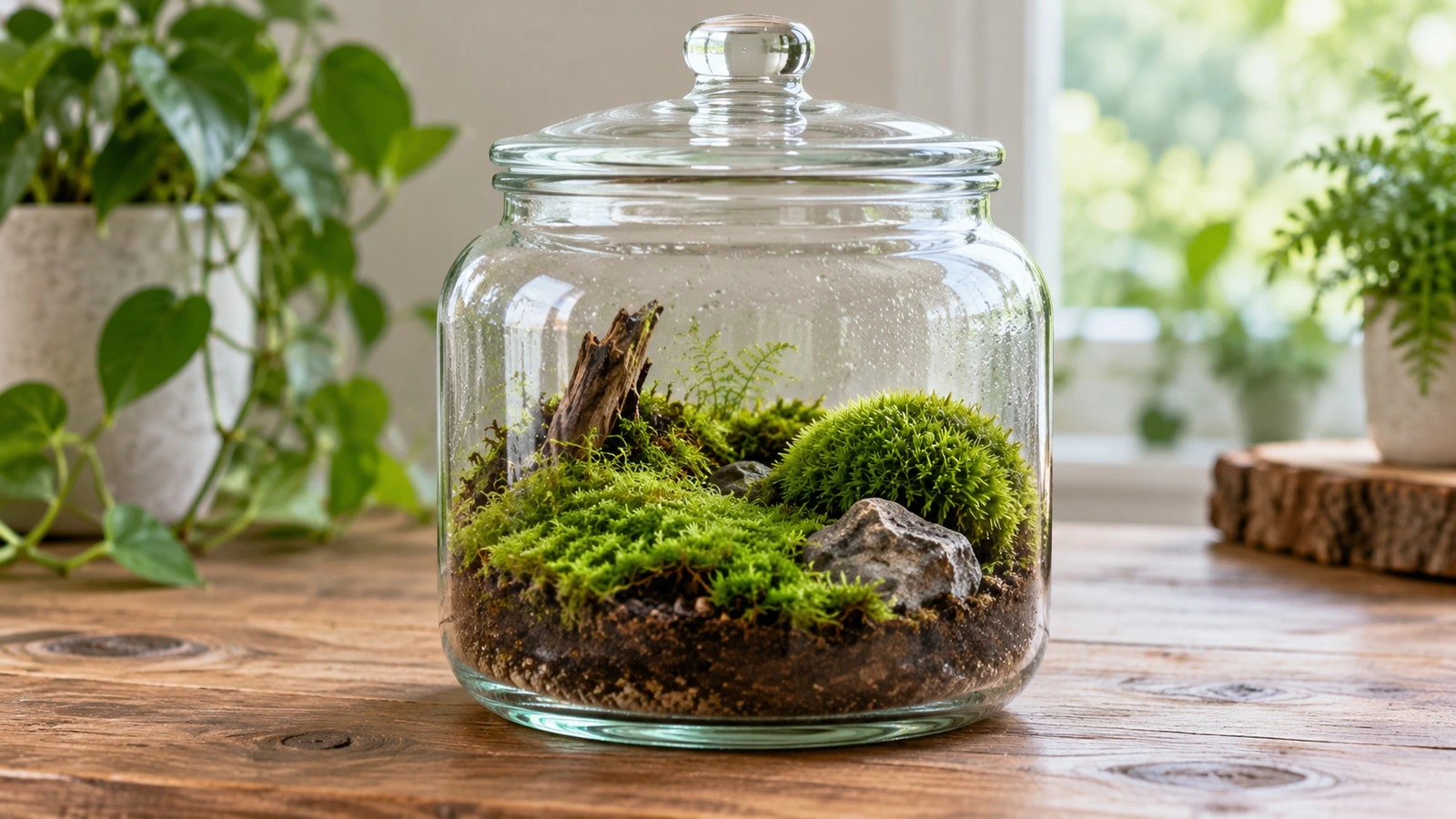
To make a moss terrarium, start with a clean, clear container, live moss, a damp growing mix, and just a little water. Moss likes moisture and humidity, but it does not need to sit in soggy soil.
For most beginners, a closed or mostly closed jar is the easiest setup. The lid helps hold humidity around the moss, while the glass lets you watch the moisture level and make small adjustments when needed.
You do not need a complicated build. You can make a simple moss terrarium with one or two types of live moss, a little soil, a few stones or pieces of wood, and bright indirect light.
Moss Terrarium Supplies at a Glance
| Item | Need It? | Why |
|---|---|---|
| Clear container with lid | Yes | Holds humidity and lets in light |
| Live moss | Yes | The main living plant in the terrarium |
| Light potting or terrarium mix | Yes | Holds moisture without becoming a muddy mass |
| Misting bottle or small water dropper | Helpful | Lets you add very small amounts of water |
| Tweezers, chopsticks, or a spoon | Helpful | Makes placement easier in a jar |
| Rocks or wood | Optional | Adds shape and gives moss more surfaces to grow over |
| Gravel | Optional | Can be decorative, but it is not required for every terrarium |
| Horticultural charcoal | Optional | Commonly used in closed terrariums, but not essential to every build |
Which Moss Is Best for a Terrarium?
For a beginner moss terrarium, choose live moss that naturally grows in damp, shaded conditions and stays fairly compact.
Sheet moss is useful when you want a flat green carpet across soil, stone, or wood. The University of Maryland describes sheet moss as a type that often grows in broad mats on soil, rocks, and logs.
Cushion-forming moss is useful when you want rounded green mounds. Some common mosses naturally grow in clumps rather than flat sheets, which can make a terrarium look more like a tiny forest floor.
You can also combine a flat moss with a cushion-forming type. The different shapes create more depth without adding more plant species.
If you want a living terrarium, buy live moss rather than preserved decorative moss. Preserved moss can look green, but it is meant for decoration rather than continued growth.
Common names can vary from one seller to another, so focus less on the label and more on the moss’s growing conditions. Healthy live moss that likes steady moisture and indirect light is the safer choice.
Should a Moss Terrarium Be Open or Closed?
Most beginner moss terrariums are easier to manage in a closed or mostly closed container because the lid slows water loss and keeps humidity high.
Penn State Extension lists moss as a natural choice for a closed terrarium because it suits moist conditions. A closed container can also recycle moisture, so you may go a long time without adding more water once the terrarium is balanced.
An open moss terrarium can work, but it dries faster. That means you will need to watch the moss and growing mix more closely and add water more often.
Whichever style you choose, avoid direct sun. A glass container can heat up quickly, especially with a lid. Bright indirect light is a much safer target.
How to Make a Moss Terrarium Step by Step
1. Clean the Container
Wash the jar or glass container with warm, soapy water, rinse it well, and let it dry. Starting clean lowers the chance of bringing old dirt or unwanted growth into the terrarium.
A wide-mouth jar is easiest for a first build because you can reach inside. Narrow-neck containers can work, but they usually require longer tweezers, chopsticks, or a small spoon.
2. Add the Bottom Layer, If You Want One
A layer of gravel or small stones is optional. Older terrarium instructions often treated gravel as required drainage, but newer guidance from Penn State notes that gravel is not necessary in every terrarium.
The important part is controlling how much water you add. A glass jar has no drainage hole, so extra water cannot escape no matter how many stones are underneath the soil.
If you like the look of gravel, use a shallow layer and think of it as part of the design rather than a substitute for careful watering.
3. Add a Light, Moist Growing Mix
Add enough potting or terrarium mix to give the moss a stable surface. For a small jar, a layer around 1 to 2 inches deep is often enough unless you are creating hills or adding rooted plants.
The mix should feel damp, not muddy. A light potting mix with materials like perlite or vermiculite holds moisture while staying looser than heavy garden soil.
If the soil is already wet enough to squeeze out water, do not add more. It is much easier to add a little water later than to remove too much from a jar with no drain.
4. Place Rocks or Wood Before the Moss
If you are using stones, bark, or small pieces of wood, place them first. This gives you a basic shape to work around and prevents you from crushing moss when you move hard objects later.
Keep the layout simple. One interesting stone or a small piece of wood can create more depth than filling the jar with decorations.
5. Add the Moss
Remove loose leaves, twigs, and obvious debris from the moss. Then set small pieces where you want them and press them gently against the damp surface.
Do not bury the green growing tips. The moss should sit on top of the growing mix, with good contact underneath. Smaller pieces are usually easier to shape than one large sheet.
Leave a little open space instead of covering every inch on day one. The terrarium will look more natural, and the moss has room to spread.
6. Attach Moss to Rocks, If Needed
Moss growing on a flat or gently sloped rock can often be pressed into place or tucked into damp growing mix around the stone.
On a steeper surface, a loose wrap of cotton thread can hold the moss against the rock or wood while it settles in. The Philadelphia Orchard Project also lists thread as a simple way to secure moss to sticks or rocks in a terrarium.
Use only enough thread to hold the moss in contact with the surface. You do not want to crush it under a tight wrap.
7. Mist Lightly and Close the Jar
Mist the moss and soil lightly. You want the surfaces evenly damp, not dripping wet.
If the jar already contains plenty of moisture, you may only need a few sprays. After the leaves and glass are no longer dripping, put the lid on.
A little condensation is normal in a closed terrarium. Heavy fog or large droplets covering the glass all day usually means there is too much moisture. Open the lid for a while and let some of it escape.
8. Put the Terrarium in Bright Indirect Light
Place the finished terrarium where it gets bright indirect light. Avoid a sunny windowsill where the glass can trap heat.
Do not treat low light as no light. Moss can tolerate shade, but it still needs enough light to photosynthesize and keep growing.
What Is the Best Soil for a Moss Terrarium?
The best soil for a moss terrarium is a light growing mix that stays evenly moist without turning into mud.
A simple indoor potting mix or soilless terrarium mix can work well. The University of Vermont recommends a light potting soil containing perlite and/or vermiculite for terrariums. Penn State also recommends using fresh potting mix rather than heavy outdoor soil.
Moss does not need rich, heavily fertilized soil. In a closed container, fast growth is not always a benefit because everything has limited space.
The bigger issue is moisture. If the growing mix stays waterlogged, the terrarium can develop rot, algae, or mold problems. Aim for damp, not soaked.
How Do You Make a Moss Terrarium in a Jar?
A jar is one of the easiest containers for a moss terrarium. The process is the same as any other closed moss setup: clean the jar, add a light growing mix, place any rocks or wood, press in the live moss, mist lightly, and close the lid.
A wide-mouth jar is easier to plant and clean. A narrow-mouth jar can still work, but use long tweezers, chopsticks, or a spoon taped to a stick to reach the bottom.
Do not overfill the jar. Leave visible space above the moss and around any hardscape so the finished terrarium does not look cramped.
How Often Should You Mist a Moss Terrarium?
Do not mist a closed moss terrarium on a fixed schedule. Watch the terrarium instead.
If the moss is green, the growing mix is still damp, and you see a normal moisture cycle on the glass, leave it alone. A well-balanced closed terrarium may go for weeks or even months without added water.
Mist only when the growing mix is starting to dry and the moss no longer looks evenly hydrated. Add a small amount, then wait and watch before adding more.
The University of Vermont notes that a tightly sealed terrarium may not need additional water for months. If too much moisture collects on the glass, briefly opening the lid can help the excess evaporate.
Common Moss Terrarium Mistakes
Most beginner problems come from too much water, too much heat, or the wrong type of moss.
- Soaking the soil. Moss likes moisture, but a swampy bottom creates problems.
- Putting the jar in direct sun. Glass can trap heat and quickly damage the moss.
- Using preserved moss and expecting it to grow. Decorative moss is not the same as living moss.
- Packing moss too tightly. Good contact is useful; crushing it is not.
- Adding water because a few droplets disappear. Judge the whole terrarium, not one dry spot on the glass.
- Mixing moss with plants that want very different conditions. One small container should have one basic moisture and light environment.
When something looks wrong, change one thing at a time. Dumping in more water, moving the jar to a sunny window, and opening the lid all at once makes it harder to tell what actually helped.
Can You Add Other Plants to a Moss Terrarium?
Yes. Moss works well as ground cover around small plants that enjoy the same humid conditions.
Good companions can include compact ferns, fittonia, pilea, selaginella, and other small humidity-loving plants. If you want help choosing compatible plants, see what plants are good for terrariums before you plant the jar.
Keep the number of plants modest. A moss terrarium does not need to look full on the first day. Open space gives everything room to grow and makes the container easier to maintain.
The Bottom Line
Learning how to make a moss terrarium comes down to balance. Use live moss, a clean, clear container, a light, damp growing mix, and bright indirect light. Add water carefully and let a closed jar hold the humidity for you.
For a first project, keep the design simple. A wide-mouth jar, a patch of sheet or cushion-forming moss, one rock, and a small amount of soil are enough to make a healthy-looking miniature landscape.
Once you plant the terrarium, watch the moisture instead of following a watering calendar. If the moss stays green and the soil stays lightly damp, the best thing you can often do is leave it alone.
Until next time.

Browse more Terrarium guides.
Sources and Further Reading
- Penn State Extension – Creating a Closed Terrarium
- University of Vermont Extension – Creating a Garden in a Terrarium
- University of Maryland Extension – Moss in the Landscape
- Philadelphia Orchard Project – How to Make Moss Terrariums