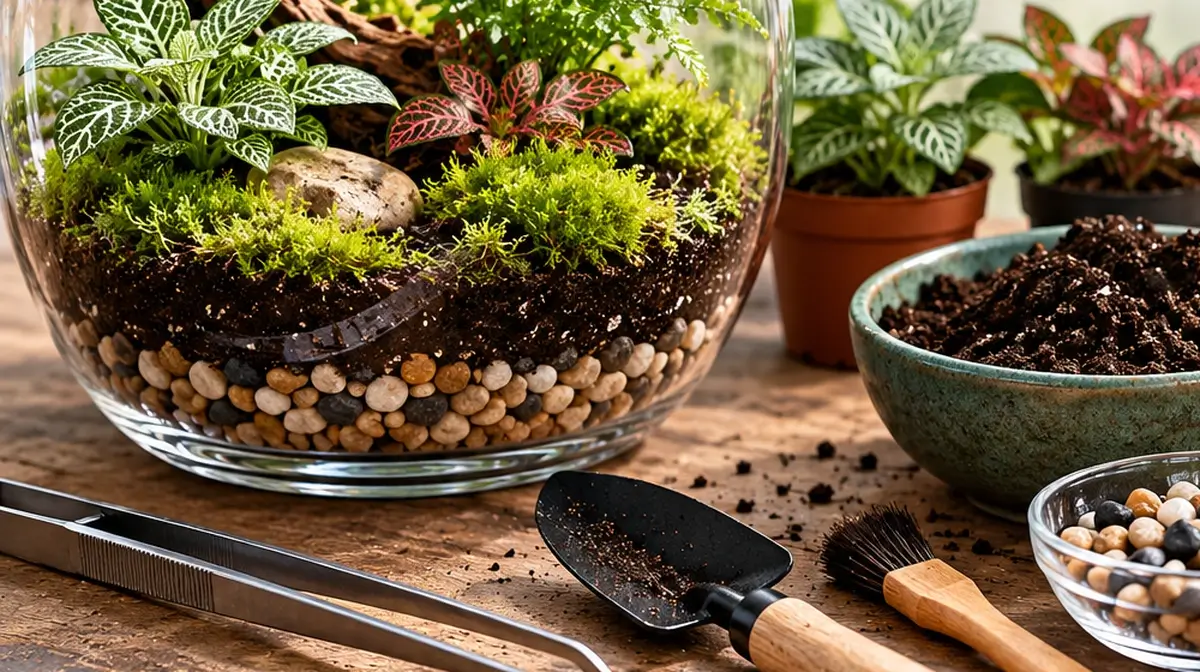
What do you need to make a terrarium? At minimum, you need a clear container, suitable potting mix, a few compatible plants, a way to add water carefully, and a few basic planting tools. Everything else—from decorative stones to long tweezers—is either optional or depends on the type of terrarium you want to build.
You do not need an expensive kit or a box full of specialty tools. You can make a simple terrarium with supplies you may already have at home.
Terrarium Supplies at a Glance
| Item | Do You Need It? | Why |
| Clear container | Yes | Holds the plants and lets in light |
| Potting mix | Yes | Supports roots and holds moisture |
| Small compatible plants | Yes | The living part of the terrarium |
| Water | Yes | Needed to establish the plants |
| Spoon or small planting tool | Helpful | Makes planting easier |
| Mister or small watering container | Helpful | Helps control the amount of water |
| Long tweezers or chopsticks | Helpful | Useful in deep or narrow containers |
| Gravel or decorative stones | Optional | Mostly decorative |
| Activated charcoal | Optional | Sometimes used in terrariums |
| Moss and decorations | Optional | Adds appearance and surface cover |
The exact supplies can change depending on whether you are making an open or closed terrarium.
Start With a Clear Container
Almost any clear glass or plastic container can work as a terrarium, as long as it gives the plants enough room.
University of Missouri Extension lists containers such as fishbowls, aquariums, glass jars, bottles, and other clear vessels. Tinted or cloudy containers are less useful because they reduce the amount of light reaching the plants.
For a closed terrarium, choose a container you can cover or seal.
For an open terrarium, use a container with an uncovered opening at the top or side.
A wide opening makes planting and maintenance much easier. Narrow-neck containers can look interesting, but they usually require longer tools and more patience.
Choose Potting Mix, Not Garden Soil
Your plants need a growing medium that holds moisture without becoming a heavy, muddy mass.
Fresh potting mix made for container plants is usually the simplest choice.
Penn State Extension recommends a soilless potting mix for closed terrariums and warns that ordinary garden soil is too heavy and can compact inside the container. University of Missouri Extension also recommends a clean, well-drained growing medium with plenty of organic matter.
The exact mix should match the plants.
Tropical foliage plants may do well in a general indoor potting mix, while succulents need a faster-draining mix designed for plants that prefer drier conditions.
You do not need to become a soil scientist to make your first terrarium. Start with a clean commercial mix that suits the plants you chose.
Pick Plants That Can Live Together
Plant compatibility matters more than how good the plants look side by side at the garden center.
Plants in one terrarium should have similar needs for:
- Moisture
- Humidity
- Light
- Temperature
- Growing space
For closed terrariums, small tropical foliage plants, miniature ferns, mosses, pileas, and peperomias are common choices.
Open terrariums offer more flexibility and can also suit plants that prefer drier conditions. University of Minnesota Extension recommends choosing plants with similar water and light requirements and considering their mature size before planting.
Avoid buying plants only because they are tiny today. A plant that quickly outgrows the container creates more work later.
Do You Need Gravel in a Terrarium?
Not necessarily.
Many terrarium kits and older instructions include a bottom layer of gravel or pebbles and describe it as drainage.
Penn State Extension notes that a layer of rocks is not required and is no longer considered an effective way to improve drainage in a terrarium. You can still use gravel if you like how it looks.
That distinction matters.
A decorative rock layer is fine.
It doesn’t permit you to overwater the terrarium.
The exact arrangement of terrarium layers is a subject of its own, so you don’t need to turn your materials list into a complicated construction project before you start.
Do You Need Activated Charcoal?
Activated or horticultural charcoal appears in many terrarium instructions and commercial kits.
Some extension guides recommend charcoal as part of the terrarium setup, particularly in closed containers. Other modern terrarium instructions focus more heavily on fresh growing media, cleanliness, and careful watering.
That makes charcoal useful to know about, but I wouldn’t treat it as the factor that determines whether a terrarium succeeds or fails.
If a kit includes horticultural charcoal, you can use it according to the instructions.
If you are building a simple terrarium yourself, focus first on the essentials: the right container, compatible plants, suitable potting mix, proper light, and careful watering.
Which Tools Do You Need?
You already own most of the tools you need for a basic terrarium.
Useful basic tools include:
- A large spoon
- Small scissors
- Chopsticks
- A small mister or spray bottle
- A small watering container
University of Missouri Extension recommends simple household tools such as scissors, a kitchen spoon, long sticks, and a sprayer.
You do not need specialized terrarium tools just because they are sold as a set.
Specialty tools become more useful when the container is deep or difficult to reach.
Are Long Tweezers Useful for Terrariums?
Yes, especially once your hands cannot comfortably reach the planting area.
Long terrarium tweezers can help you:
- Position small plants
- Move moss
- Remove dead leaves
- Place decorations
- Pick debris from the soil.
- Work without disturbing nearby plants
University of Minnesota Extension specifically mentions long terrarium tweezers, shovels, and rakes as tools that can make plant placement easier.
For a wide glass bowl, you may barely use them.
For a tall jar or narrow opening, they can make the job much easier.
So I would call long tweezers helpful, not required.
What Tools Help With a Narrow-Neck Terrarium?
This is where specialized—or improvised—tools become much more useful.
A narrow opening may prevent you from reaching the planting area with your hands.
Useful options include:
- Long tweezers
- Chopsticks
- Bamboo sticks
- Long-handled spoons
- Small funnels
- Barbecue tongs
- A spoon attached to a stick
- A small watering tube or baster
The Royal Horticultural Society recommends improvised tools such as chopsticks, barbecue tongs, or a spoon attached to a cane when planting through a narrow opening. University of Missouri Extension suggests long sticks, funnels, kitchen spoons, and similar tools for hard-to-reach containers.
You can buy a terrarium tool kit if you plan to make several terrariums, but you don’t need one for your first project.
Kitchen drawers have launched plenty of miniature gardens.
What Should a Terrarium Kit Include?
A useful terrarium kit should include what you actually need, not a large collection of decorative filler.
At a minimum, look for:
- A suitable container
- Potting or growing mix
- Plants or clear guidance about which plants to buy
- Any materials specifically required by the kit’s design
- Basic instructions
Helpful extras may include:
- Long tweezers
- Small planting tools
- A mister
- Moss
- Decorative stones
- Horticultural charcoal
One thing to check carefully is whether the kit includes live plants. Some kits provide the container and planting materials but expect you to buy plants separately.
Also make sure the plant type matches the container. A sealed terrarium kit should not rely on plants that prefer dry, open conditions.
How Much Does It Cost to Make a Terrarium?
There is no single price.
The cost depends largely on what you already own.
A terrarium can be inexpensive if you reuse a glass jar, already own small tools, and buy only a few plants and some potting mix.
The price goes up when you choose:
- A purpose-made decorative terrarium
- Several specialty plants
- A complete tool set
- Decorative stone or wood
- Specialty moss
- Lighting
- A packaged terrarium kit
For a first terrarium, I would spend money on healthy plants and an appropriate growing mix before decorative accessories.
You can always add decorations later.
Should You Buy a Terrarium Kit or Build Your Own?
Both approaches can work.
A Kit May Be Better If:
- You want everything gathered in one package.
- You are buying the terrarium as a gift.
- You do not already own basic supplies.
- You like a particular container included in the kit.
Building Your Own May Be Better If:
- You already have a container.
- You want to choose your own plants.
- You want more control over the materials.
- You plan to make several terrariums.
- You do not want to pay for supplies you already own
Building your own also makes it easier to match the plants, potting mix, and container rather than accepting whatever combination comes in a kit.
Neither approach is automatically better.
The best choice is the one that gets you the right materials without buying things you don’t need.
What You Can Skip for Your First Terrarium
Terrarium shopping can get complicated quickly because almost every supply can become a specialty product.
For your first build, you probably do not need:
- Expensive miniature tools
- Elaborate decorations
- Large bags of specialty stone
- Multiple soil additives
- Tiny figurines
- A complicated watering system
- A giant collection of plants
Start simple.
A clear container, suitable growing mix, a few compatible plants, water, and basic household tools are enough to get started.
After you have built one terrarium, you will have a much better idea of which extras are actually useful to you.
Start With the Essentials
What do you need to make a terrarium? Much less than the supply aisle may lead you to believe.
Start with a clear container, good potting mix, a few healthy plants with similar needs, and simple tools for planting and watering.
Add long tweezers if the container is hard to reach. Add decorations if you enjoy them. Buy a kit if convenience matters more than choosing every part yourself.
The important thing is not how much equipment you own. It is whether the container, plants, growing mix, moisture, and light work together.
Until next time.

Browse more Terrarium guides.
Sources and Further Reading
- University of Missouri Extension — Terrariums
- Penn State Extension — Creating a Closed Terrarium
- University of Minnesota Extension — Terrarium Gardening
- Royal Horticultural Society — Terrariums and Bottle Gardens