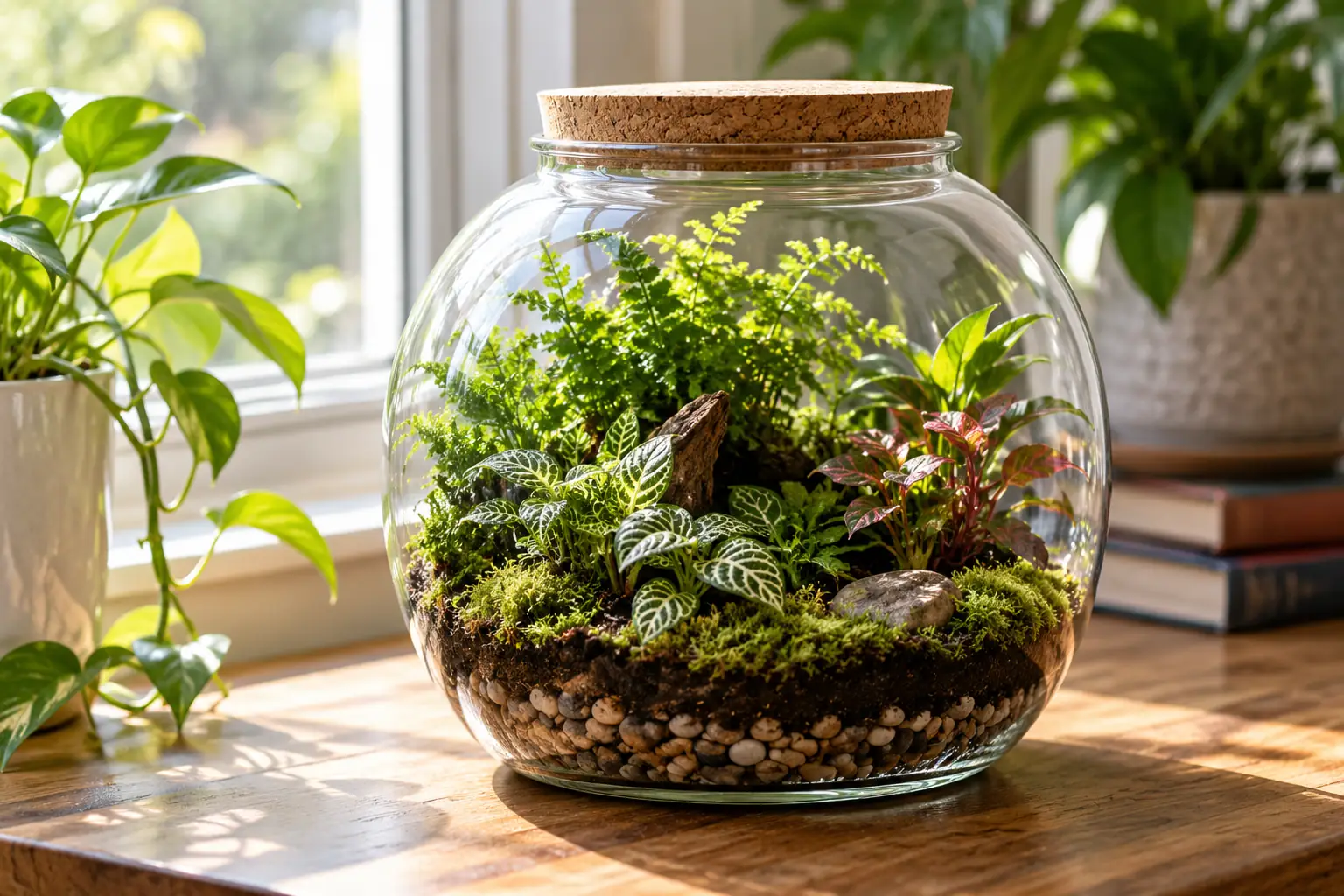
Do terrariums need sunlight? They need enough light for their plants to grow, but most closed terrariums do best in bright, indirect light rather than direct sun. Direct sunlight through glass can quickly heat a terrarium, while a dim room may not provide enough energy for healthy growth. Natural window light can work well, and a grow light can replace or supplement it when needed.
How Much Light Does a Terrarium Need?
The right amount of light depends on the plants, the terrarium type, and where it sits in the room. Many common closed-terrarium plants are tropical or woodland species that prefer medium to bright indirect light.
A typical closed terrarium usually does not need the strongest light in the house. Iowa State University Extension recommends medium to bright indirect sunlight and notes that an east- or north-facing window is often a good choice. Penn State and Oklahoma State also recommend bright light while warning against direct sun on closed containers.
Open terrariums can vary more. An open terrarium filled with moisture-loving foliage plants may prefer conditions similar to a closed terrarium, while an open succulent terrarium can need much brighter light. Match the light to the plants instead of assuming every glass container needs the same location.
Why Direct Sunlight Can Overheat a Terrarium
A closed terrarium should not sit in strong direct sunlight. Light passes through the glass and warms the soil, plants, air, and hardscape inside. Because the container is enclosed, that heat can build faster than it would around a normal potted plant.
University extension guides use unusually strong language about this risk. Penn State says a closed terrarium in direct sunlight can “cook,” while Oklahoma State says direct sun can quickly overheat the container. You do not need to measure the glass temperature to take the warning seriously.
If the terrarium receives a beam of direct sun for part of the day, move it farther from the window, use a sheer curtain, or choose a window with gentler exposure. The goal is bright light without turning the container into a miniature greenhouse on a hot day.
Which Window Direction Is Best?
For a typical closed tropical terrarium, an east- or north-facing window is a good starting point because it often provides useful light with less intense heat than a sunny south- or west-facing window.
Window direction is only a shortcut, though. Trees, roof overhangs, curtains, seasons, and distance from the glass can change the actual light level. A north window may be too dim in one house and perfectly adequate in another. An east window may be excellent in summer but weaker in winter.
Watch the plants instead of treating the compass direction as a rule. If growth becomes stretched, pale, sparse, or strongly leans toward the window, the terrarium may need more light. If leaves bleach, scorch, or develop crispy patches, the light may be too intense.
Can a Terrarium Survive Without Natural Sunlight?
Yes. A plant terrarium can grow without natural sunlight if it receives enough suitable artificial light. This makes terrariums possible in offices, interior rooms, basements, and other places where window light is weak or unavailable.
A grow light should provide useful plant light, not just make the terrarium look bright to your eyes. White or balanced-spectrum grow lights are a practical choice for most foliage plants. A timer also makes the light period consistent from day to day.
Artificial light does not remove the need to watch the plants. If the terrarium is stretching toward the fixture, becoming thin, or losing color, it may need more light. If leaves fade or scorch, the lamp may be too intense or too close.
Can You Use a Grow Light for a Terrarium?
Yes. A grow light can supplement a dim window or serve as the main light source. This is especially useful when the only available window puts the terrarium in direct sun or when a room stays too dark during winter.
For foliage houseplants, University of Minnesota Extension recommends white or balanced grow lights and notes that light intensity, duration, and distance all matter. The fixture does not have to be labeled specifically for terrariums; it needs to provide the type and amount of light the plants require.
Avoid lamps that add a lot of heat close to a closed container. Modern LEDs are usually easier to manage than hot incandescent bulbs, but even an LED should not be pressed against the lid or glass.
How Many Hours of Light Does a Terrarium Need?
No single daily light schedule fits every terrarium. Natural light changes through the year, different plants have different needs, and a weak lamp often needs to run longer than a powerful one.
When a grow light is the main source for foliage plants, about 12 to 14 hours per day is a reasonable starting point based on University of Minnesota guidance for foliage houseplants. Illinois Extension notes that 14 to 16 hours can be useful in lower-light conditions. That range is a starting point, not a promise that every terrarium needs the same timer setting.
Give the terrarium a dark period too. Leaving a light on around the clock is unnecessary for ordinary terrarium plants and doesn’t make up for poor light quality or placement.
How Far Should a Grow Light Be From a Terrarium?
The correct distance depends on the fixture. A small LED bar, a powerful grow panel, and an old fluorescent tube can produce very different light levels and heat.
University of Minnesota lists about 12 to 24 inches as a general distance for foliage houseplants under artificial lights. That can be a useful starting range for a foliage terrarium, but the manufacturer’s directions and the plants’ response matter more than one fixed number.
Start far enough away to avoid excess heat and bleaching. Move the light closer only if the terrarium is clearly not getting enough light. If the fixture feels hot at the glass or raises the temperature inside the container, increase the distance.
Signs a Terrarium Is Getting Too Little or Too Much Light
Possible signs of too little light include:
- Long, thin, stretched stems.
- Wide spaces between leaves.
- Plants leaning strongly toward the light source.
- Variegated leaves becoming more solid green.
- Slow or weak growth.
Possible signs of too much light include:
- Bleached or pale patches on leaves.
- Brown, crispy, or scorched areas.
- A closed container becoming noticeably hot.
- The terrarium drying much faster than usual.
Light can also change how quickly the soil dries. If you adjust the terrarium to a brighter or warmer location, check moisture before automatically adding more water. See How to Water a Terrarium for the watering routine.
A Simple Terrarium Lighting Routine
- Identify the light needs of the plants inside the terrarium.
- For a typical closed terrarium, start with bright indirect light rather than direct sun.
- Use an east- or north-facing window as a practical starting point when available.
- If natural light is weak, add a grow light instead of moving a closed terrarium into hot direct sun.
- Use a timer if the grow light is the main light source.
- Watch the plants for stretching, bleaching, scorching, or other changes and adjust gradually.
If healthy plant growth starts crowding the container, our guide to how to prune terrarium plants explains how to keep things under control.
The Bottom Line
Terrariums need light, but most closed terrariums do not need direct sunlight. Bright indirect light is usually the safest starting point for a closed tropical terrarium because it gives the plants useful light without the heat buildup caused by strong sun through glass.
If your room does not provide enough natural light, a grow light can work well. Start with the plants’ needs, use a timer when helpful, and adjust the distance or duration based on how the terrarium responds rather than chasing one universal number.
Until next time.

Browse more Terrarium guides.
Sources and Further Reading
- Penn State Extension – Creating a Closed Terrarium
- Iowa State University Extension and Outreach – How to Create and Care for a Terrarium
- Oklahoma State University Extension – Terrariums
- University of Missouri Extension – Terrariums
- University of Minnesota Extension – Lighting for Indoor Plants and Starting Seeds
- Illinois Extension – Lighting for Houseplants