
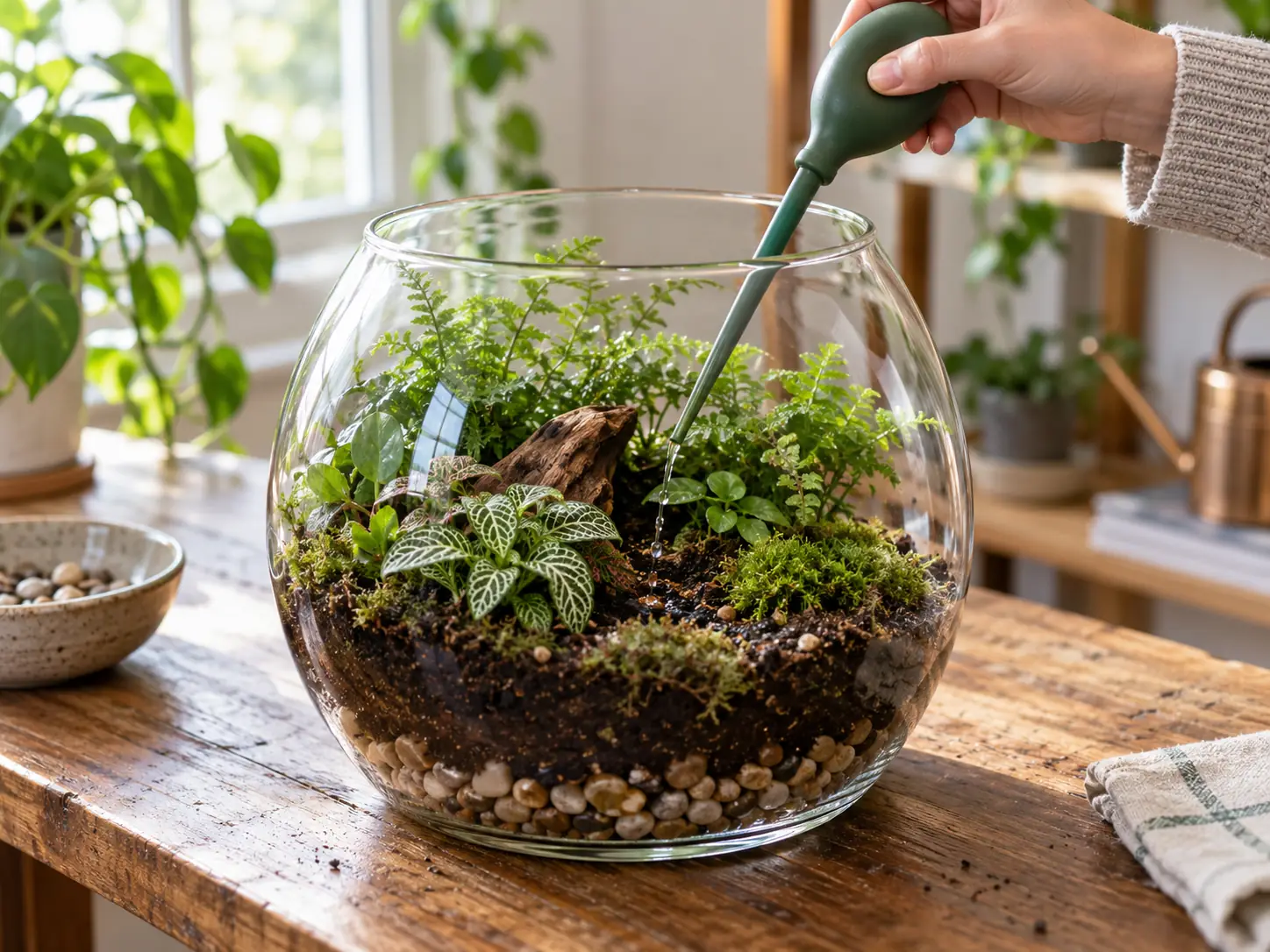
How to water a terrarium depends first on whether it is closed or open. A closed terrarium recycles much of its water so that it may need very little added moisture. An open terrarium loses water to the room and needs more frequent checks. In both cases, the safest approach is to add water slowly, aim it at the soil, and stop before the growing mix becomes soggy or water collects at the bottom.
Closed and Open Terrariums Need Different Watering
A closed terrarium works like a small water cycle. Moisture moves from the soil into the plants and air, condenses on the glass, and returns to the soil. Once that cycle is balanced, you may go a long time without adding water.
An open terrarium cannot recycle moisture as efficiently because water vapor escapes into the room. Its soil usually dries faster, so you need to check it more often.
That does not mean every closed terrarium can follow one schedule or every open terrarium can follow another. Container size, lid fit, potting mix, plant choice, room temperature, humidity, and light all affect how quickly water is used or lost. Treat the calendar as a reminder to check the terrarium, not as an automatic signal to water it.
Light also affects moisture levels. Our guide to how much sunlight a terrarium needs explains how to give plants enough light without overheating the container.
How to Water a Closed Terrarium
Before adding water to a closed terrarium, look for signs that it actually needs it. If the soil still looks damp and you still see condensation, adding more water may do more harm than good.
When the soil is noticeably drier, condensation has stopped for an extended period, or the plants show signs of thirst, add water in small amounts.
- Open the lid and inspect the soil.
- Add a small amount of water directly to the soil around the plants.
- Use a narrow-spout bottle, bulb baster, spoon, or spray bottle on a coarse stream so you can control where the water goes.
- Pause and let the moisture spread through the potting mix before deciding whether more is needed.
- Stop before the soil becomes saturated or water begins collecting at the bottom.
If the leaves get wet, let them dry before closing the terrarium again. Wet foliage can stay damp for a long time inside a closed container.
Condensation is useful, but it should not be your only test. Temperature changes can affect when condensation appears. Consider the glass, the soil, and the plants’ condition together.
How Often Does a Closed Terrarium Need Water?
A closed terrarium does not need to be watered on a fixed weekly schedule. A well-balanced one can often go for months without added water, while a container with a loose-fitting lid may dry faster.
A better habit is to check it every few weeks instead of watering on a set schedule. Look at the soil, watch the plants, and notice whether the normal moisture cycle is still happening.
If everything still looks moist and healthy, leave it alone. One of the easiest ways to damage a closed terrarium is to keep adding water simply because a certain number of days have passed.
How to Water an Open Terrarium
An open terrarium loses more water through evaporation, so it normally needs more attention than a closed one. Even so, water according to the plants and the soil’s condition rather than a rigid schedule.
Check the soil before watering. When it has dried to the level that suits the plants you are growing, add a small amount of water near the base of each plant. Give the moisture time to soak into the root zone before adding more.
Open terrariums with succulents or cacti should dry out much more between waterings than open terrariums with plants that prefer consistently moist soil.
The lack of a lid does not turn an open terrarium into a normal flowerpot. Many terrarium containers still have no drainage holes, so excess water has nowhere to escape.
How Much Water Should You Add to a New Terrarium?
There is no dependable one-size-fits-all amount. A small jar with already-moist potting mix may need very little water, while a larger container planted in drier mix will need more.
For a new terrarium, aim to keep the soil evenly moist around the root zones without soaking the entire container. Add water a little at a time and watch how the soil responds.
If you started with moist potting mix, a light watering or misting may be enough to settle the soil around the roots. It is much easier to add a little more water later than to remove water from a container with no drainage.
With a new closed terrarium, watch it closely during the first several days. If the glass stays heavily fogged or large droplets constantly cover the inside, open the lid and allow some moisture to escape before sealing it again.
Can You Use Tap Water in a Terrarium?
For most common terrarium plants, ordinary tap water is usually acceptable. You do not automatically need distilled water.
Water quality does vary, though. Hard water can leave mineral deposits on the glass and in the potting mix, and water softened with sodium salts is not a good choice for most houseplants. Because a terrarium is not normally flushed with large amounts of water, those minerals and salts can be harder to wash out once they build up.
If your tap water leaves heavy mineral deposits, comes through a household water softener, or causes problems with sensitive plants, consider rainwater, distilled water, or reverse-osmosis water instead.
Plant choice still matters. Water a terrarium with a species with special water-quality needs according to that plant’s requirements.
Should You Mist or Pour Water Into a Terrarium?
Both methods can work. The better choice depends on why you are adding water.
Misting is useful when you are building a new terrarium, settling the potting mix, washing soil off the glass, or adding a very small amount of moisture. A spray bottle set to a coarse stream also gives you more control than a heavy pour.
When the root zone actually needs water, a small targeted pour is often easier to control. A narrow-spout bottle, spoon, pipette, or bulb baster lets you place water directly on the soil instead of soaking the foliage.
Try not to keep the leaves constantly wet, especially in a closed terrarium. Moisture that sits on foliage can dry slowly in the humid container.
The goal is not to choose one watering tool forever. The goal is to deliver the smallest useful amount of water to where it’s needed.
Signs You Added Too Much Water
A terrarium that is too wet may show heavy, persistent condensation, soggy potting mix, or visible water collecting at the bottom of the container.
If a closed terrarium is too humid, remove or crack the lid and let some moisture escape. If water has pooled where you can reach it, you may be able to carefully tilt the container and wick away some excess with a paper towel.
Don’t add more water until the terrarium returns to a better moisture balance.
Wilting or yellowing does not always mean a plant is thirsty. Those symptoms can have several causes, including too much water, so check the soil before reaching for the watering bottle.
A Simple Terrarium Watering Routine
You can reduce most watering mistakes by following the same basic routine:
- Identify whether the terrarium is closed or open.
- Check the soil before adding water.
- In a closed terrarium, also look at the normal condensation pattern.
- Add a small amount of water directly to the soil or root zone.
- Wait and watch before adding more.
- Stop before the soil becomes saturated or water begins to pool.
Small corrections are safer than big ones. A terrarium can usually handle being a little drier for a short time better than it can handle sitting in water.
For the rest of the routine beyond watering, see How to Care for a Terrarium.
The Bottom Line
The best way to water a terrarium is to respond to the terrarium in front of you rather than follow a fixed schedule. Closed terrariums recycle moisture and may go months without added water. Open terrariums dry faster, but they still need careful watering because many have no drainage.
Check first, add a little at a time, and let the water spread before adding more. In a terrarium, restraint is usually easier to correct than a heavy pour.
Until next time.

Sources and Further Reading
- Penn State Extension – Creating a Closed Terrarium
- Iowa State University Extension and Outreach – How to Create and Care for a Terrarium
- University of Missouri Extension – Terrariums
- Oklahoma State University Extension – Terrariums
- Virginia Cooperative Extension – Properly Watering Container Houseplants