
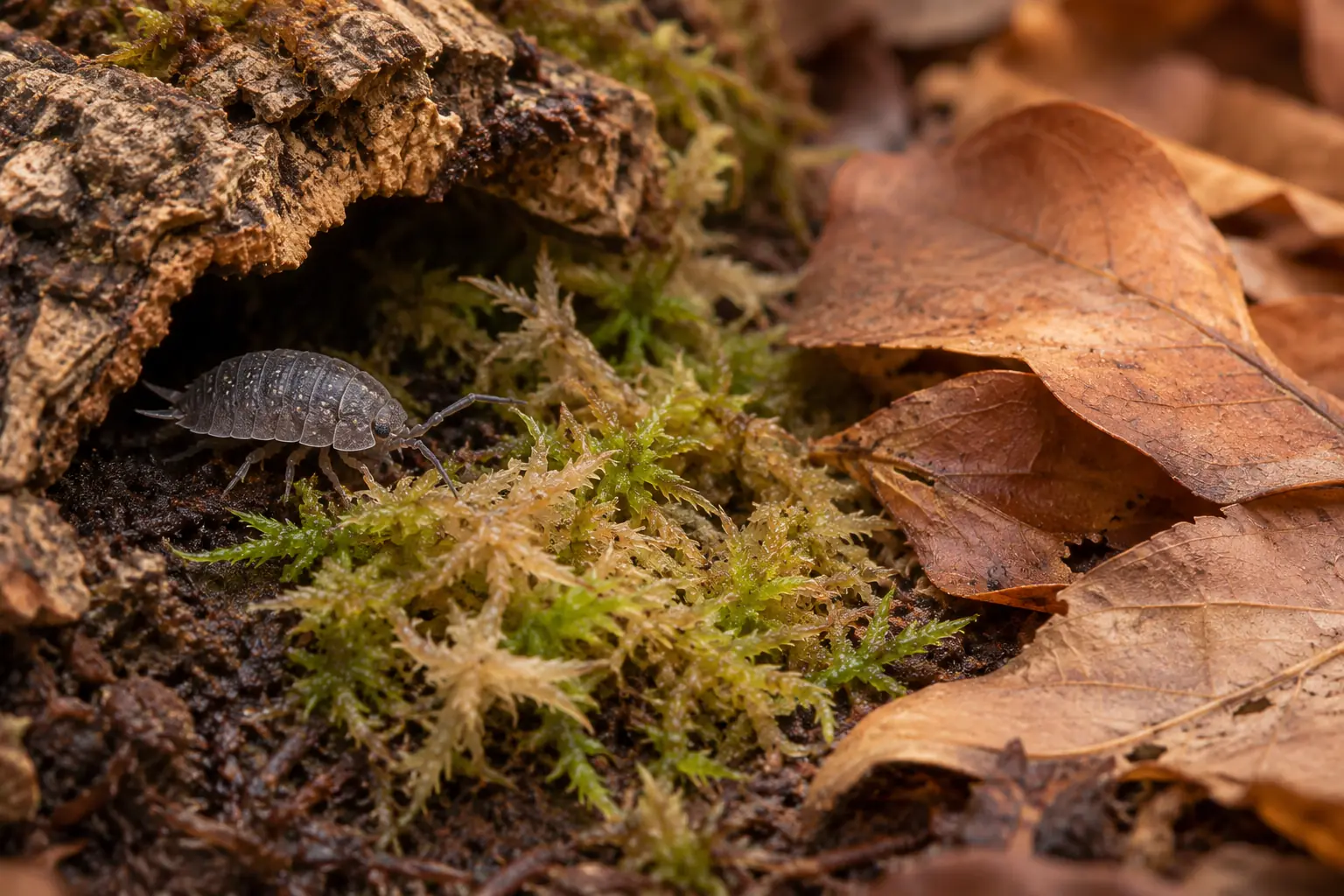
Manage isopod humidity by keeping a reliable damp refuge, suitable drier areas and ventilation, then checking the substrate beneath its cover. Match that balance to the species you keep. A humidity gauge measures air at its sensor; it cannot tell you whether the soil under a favorite hide needs water.
An isopod spends much of its life in the space beneath a leaf or piece of bark. That little sheltered pocket can have different conditions from the open air above it. To understand the colony’s moisture needs, get down to the places the animals actually use.
Separate Air Humidity From Substrate Moisture
Three related things can change around the colony. Keeping them separate makes a confusing reading easier to investigate.
| What you are checking | What it can tell you |
|---|---|
| Room air | The conditions outside the enclosure. A change in the room can alter how quickly the habitat dries. |
| Enclosure air | A hygrometer reports conditions near its sensor. That reading does not describe every covered pocket or measure water in the soil. |
| Substrate and refuge | A careful check beneath leaves or moss shows whether those materials remain damp, have dried out or are becoming waterlogged. |
Relative humidity also depends on temperature. The National Weather Service explains that the percentage can change even when the amount of water vapor stays the same. A lower reading after the air warms does not, by itself, tell you how much water to add.
If you use a hygrometer, follow its placement instructions and record temperature alongside humidity. Compare readings from the same location, and check the habitat before reacting to a change. Smug Bug’s husbandry guidance emphasizes the moisture in soil and leaf cover because that is where the animals spend their time.
Why a Damp Refuge Matters
Do isopods need water? Yes. Terrestrial species still need access to moisture, and their ability to cope with drying varies. The care methods used here maintain moist material in the habitat, with ventilation and a moisture balance suited to the animals.
There is some remarkable biology behind that need. In a 2018 study, John-David Nako and colleagues found that Armadillidium vulgare and Porcellio dilatatus actively absorbed water vapor under very humid laboratory conditions. This helped them expand their bodies around molting.
That result helps explain why access to moisture matters, but the experiment was not a test of an ideal pet-enclosure setting. It does not give every isopod keeper a humidity percentage to copy or mean that damp substrate can be replaced by a high reading on a gauge.
Maintain Choices Across the Enclosure
An isopod moisture gradient means conditions vary across the habitat, giving animals access to damper and drier places. Keep the damp refuge dependable while preserving the other conditions your species needs. Drier is a comparison with the refuge, not an instruction to let the entire colony dry out.
Breeder Springtails US describes different moisture layouts for different species and notes that local climate changes ventilation needs. Its guide also makes clear that these are methods used with particular containers and cultures. Use your supplier’s species guidance as a starting point, then check how your own enclosure behaves.
Avoid treating a half-damp, half-dry layout as a universal rule. Some species need more extensive moist areas; others need more airflow or a smaller damp zone. Ask what the species needs beneath cover, not just what percentage someone keeps on a room gauge.
A patch of sphagnum moss can help retain moisture in the refuge. Keep leaf cover and suitable shelter available elsewhere too, so the colony can use different parts of its home. Check the substrate under the moss as well as the moss itself.
Check Beneath the Cover Before Watering
Make a small, repeatable inspection rather than turning over the whole habitat. The aim is to learn what changes between checks while disturbing the animals as little as possible.
- Gently lift an accessible edge of leaf cover or a hide. Look for animals before touching the substrate or replacing the cover.
- Check the material in the damp refuge. It should retain the moisture appropriate for the species, without pooled water.
- Compare another area. Check that the enclosure still offers the intended difference between damp and drier places.
- Look through the container wall where possible. Water collecting at the bottom deserves attention even if the surface looks dry.
- Check that leaf litter, moss or nearby objects have not blocked the vents.
Aquarimax describes prepared substrate as moist rather than soaked, and recommends checking it before adding water. In an occupied colony, use a gentle inspection; you do not need to squeeze handfuls of bedding that may contain tiny animals.
The materials themselves affect what you find. Our isopod substrate guide explains the roles of soil, leaf material, wood and moss. If you change the mix, learn how the new material holds water instead of assuming the old watering routine will still fit.
How Often to Water Isopods
There is no dependable watering interval for every colony. Container design, substrate, ventilation, species and room conditions all affect the decision. Make checking a routine; make adding water a response to what you find.
This is why care sheets can appear to disagree. Carolina Biological Supply describes daily misting in its classroom care method. Aquarimax says to check the substrate and add a little water to one side when it is starting to dry. Those instructions should be read with their housing methods, not treated as competing universal rules.
When the refuge needs water, add it gradually to the intended area and let it soak in before checking again. Avoid pouring directly onto animals. A spray that wets the top leaves may not have moistened the material underneath, so check where the water actually went.
Use room-temperature water and a clean container reserved for animal care. Portland Insectarium recommends distilled water to limit mineral buildup. Keep the water free of cleaners and other additives.
Check more closely while learning a new setup and after changes such as moving the enclosure or turning on seasonal heating. Note what you added and how the refuge feels at the next check. If it remains suitably damp, another watering is not automatically due.
Adjust Water and Airflow Together
An enclosure needs to retain usable moisture while allowing air exchange. Portland Insectarium includes both requirements in its housing guidance. If one part of that balance is failing, investigate the enclosure as well as the watering amount.
When the refuge dries unexpectedly quickly, restore its moisture and check its cover, the vents, and changes in room conditions. Avoid making an airtight container simply to hold water in. If the housing needs alteration, use suitable species guidance and preserve secure ventilation.
When the substrate remains soaked or water pools, stop adding water and investigate where the excess is collecting. Check whether the intended drier area and vents are still usable. Persistent waterlogging needs a housing or substrate correction; drying the entire colony abruptly is not a useful fix.
Condensation is another clue to interpret carefully. Water can collect where moist air meets a cooler surface. A fogged wall does not prove that every patch of substrate is too wet, and a clear wall does not prove that the refuge is too dry.
Watch the animals, but avoid diagnosing the enclosure from one gathering under a hide. That spot may offer several attractions, including shelter and food. Compare behavior with the physical checks. If losses or other serious changes appear, record the conditions and recent changes and seek experienced help promptly.
The useful habit is simple: know where the damp refuge is, check beneath its cover, and notice how it changes. A gauge can add information. The little world under the leaves gives that information its meaning.
Until next time.

Browse more guides in our Isopods category.
Sources and Further Reading
- Smug Bug — Isopods, Humidity, and Moisture
- National Weather Service — Relative Humidity and Dew Point
- Nako, Lee and Wright — Water Vapor Absorption During Molting
- Springtails US — Isopod Care Guides
- Aquarimax Pets — Isopod Care
- Carolina Biological Supply — Terrestrial Isopods Care Guide
- Portland Insectarium — Isopods