
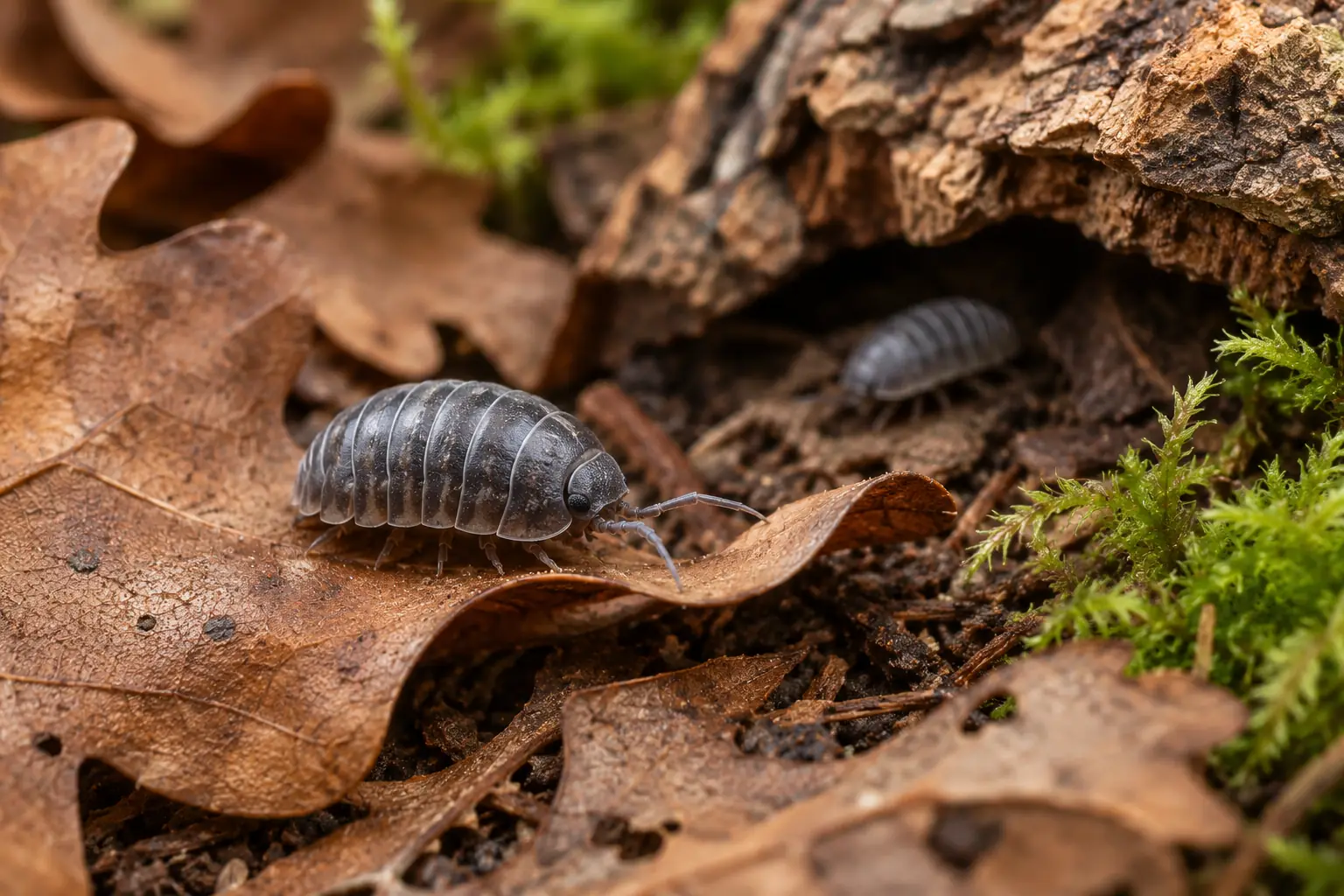
Isopod care starts with a moist refuge, fresh air, plenty of leaf litter, and conditions suited to the species you keep. Your regular jobs are to check that habitat, replace food as needed, and watch how the colony is doing. A suitable setup makes those jobs manageable, but the animals still need attention.
The reward is a small world full of things to notice. An old leaf becomes lunch. A piece of bark becomes a gathering place. Eventually, tiny youngsters may appear among the adults. You can enjoy a lot of life in a tank without needing a pet that wants to sit on your lap.
What Are Isopods
Terrestrial isopods are land-dwelling crustaceans, relatives of shrimp and crabs. You may know them as woodlice, pillbugs, sowbugs, or roly-polies. This guide covers those land animals, which live among soil and fallen leaves.
Look closely at an adult and you can see seven pairs of walking legs beneath its overlapping body plates. Some familiar pillbugs curl into a ball when disturbed. Sowbugs cannot, so an isopod that stays unrolled is not necessarily doing anything wrong.
In nature, woodlice help break dead plant material into smaller pieces. Other soil organisms continue the job. Keeping them gives you a close view of a process that usually happens out of sight, under the leaves.
Are Isopods Good Pets
Isopods can be good pets if you enjoy watching animals and tending their habitat. They suit patient observers who find a tiny creature making its way across a leaf worth stopping to watch.
They are less suitable if you want frequent handling or a pet that stays on display. Many spend daylight hours tucked beneath cover. A tank can look quiet while its residents are busy underneath.
Keep handling brief and gentle. Their small bodies are easy to injure, and time away from a moist habitat can dry them out. Watching through the enclosure, or briefly looking beneath an accessible hide, is usually more useful than picking them up.
Think about the colony as an ongoing responsibility. If it grows, you may need another enclosure or a suitable new home for some animals. Keeping isopods as pets means caring for their descendants as well as the group you first bring home.
Start With a Species You Can Identify
Before buying, get the species name and its care requirements from a knowledgeable keeper or supplier. A colorful variety name is not enough to tell you what conditions the animal needs.
Different species need different balances of moisture and ventilation. Choose one whose requirements you can maintain in your home, and keep its care information with the enclosure. A single-species starter colony also makes it easier to learn what you are observing.
In the United States, check USDA APHIS requirements before buying or arranging shipment. Its invertebrate-pet guidance says many isopod species require a permit. Confirm the requirements for the species and your location rather than assuming a seller’s listing settles the question.
Give the Colony a Habitat That Works
A useful enclosure gives isopods places to hide, food to browse, and access to moisture without trapping them in soaked conditions. Glass and plastic can both work when the enclosure has a secure lid and suitable ventilation.
Moisture and airflow belong together
These animals lose water readily, and their breathing structures depend on moisture. That helps explain why you find them beneath damp logs instead of sunbathing on a dry patio.
Many commonly kept species do well with a moist area and a drier area they can move between. The balance depends on the species. Maintain the moist refuge while allowing airflow; do not seal the colony in an airtight jar or let the entire habitat dry out.
Check the material beneath the surface leaves. A spray on top does not tell you whether the substrate below is still moist. Avoid standing water and a sodden enclosure.
The floor doubles as a pantry
Substrate is the material covering the bottom of the enclosure. For isopods, it is part of the habitat they live in and feed through. A suitable mix containing decaying organic matter, topped with leaf litter, gives them more than a bare floor to walk across.
Keep leaf litter available and replenish it as it is eaten. Add shelter, such as suitable bark, and a calcium source such as cuttlebone. Use materials intended for animal care or from a source you can trust to be free of pesticide contamination.
Small portions of suitable supplemental food can add variety. Match the food to the species and the size of the colony, and remove leftovers before they spoil. The leaves remain important even when a fresh snack gets more attention.
Match the room to the animals
Check your species’ temperature requirements and the conditions where the enclosure will sit. Commonly kept isopods do not generally need special lighting for their own sake. Keep the enclosure away from direct sun and uncontrolled heat; a decorative display still has to provide suitable living conditions.
What Everyday Isopod Care Looks Like
For a new colony, make a brief daily check part of your routine while you learn how quickly the enclosure changes. A check does not mean adding water or food every day. Let what you find guide the work.
- Check the moist refuge and add water when it needs it.
- Look for spoiled supplemental food and remove it.
- See whether the leaf cover needs topping up.
- Check that the lid and ventilation openings remain secure.
- Observe the animals without repeatedly digging through their habitat.
The amount of work changes with the enclosure, room conditions, species, and population. A small colony may barely touch a food portion that a larger colony finishes quickly. Adjust to what the animals use rather than following a fixed feeding amount.
A few notes can help: when you added water, what you offered, and anything unusual you noticed. They give you something more useful than a vague memory if the colony’s behavior changes.
Learn What Normal Looks Like
Look for a pattern over time. You may see feeding marks on leaves, animals moving beneath cover, and shed pieces of their outer shell. Isopods molt as they grow, so an empty shell is not automatically a dead animal.
Young isopods develop in a pouch beneath the female before emerging. Later, you may notice tiny, pale youngsters that resemble the adults. Enjoy the discovery without pulling the habitat apart to count them.
Neither babies nor visible feeding alone proves every condition is right. Keep checking the habitat. Likewise, a quiet afternoon does not prove something is wrong: hiding is part of normal isopod life.
Repeated deaths or a sharp change in activity deserve a closer look at conditions and species-specific advice. Record what changed before trying several fixes at once. A behavior by itself rarely tells you the whole cause.
Let the Small World Take Shape
Give your first colony time to become familiar. Notice where the animals gather, which leaves they work through, and how the enclosure changes between checks. Those observations help you care for the actual colony in front of you.
If you eventually need to rehome animals, arrange a suitable, lawful transfer. Do not release a captive colony outdoors.
One day, a leaf you barely noticed may be full of tiny feeding marks. That is part of the appeal: the longer you look, the more there is to see.
Until next time.

Browse more guides in our Isopods category.
Sources and Further Reading
- SARE — Farming with Soil Life: Woodlice
- Carolina Biological Supply — Terrestrial Isopods Care Guide
- Portland Insectarium — Isopod Care
- Springtails US — Isopod Care Guides
- University of California IPM — Pillbugs and Sowbugs
- USDA APHIS — Invertebrate Pets