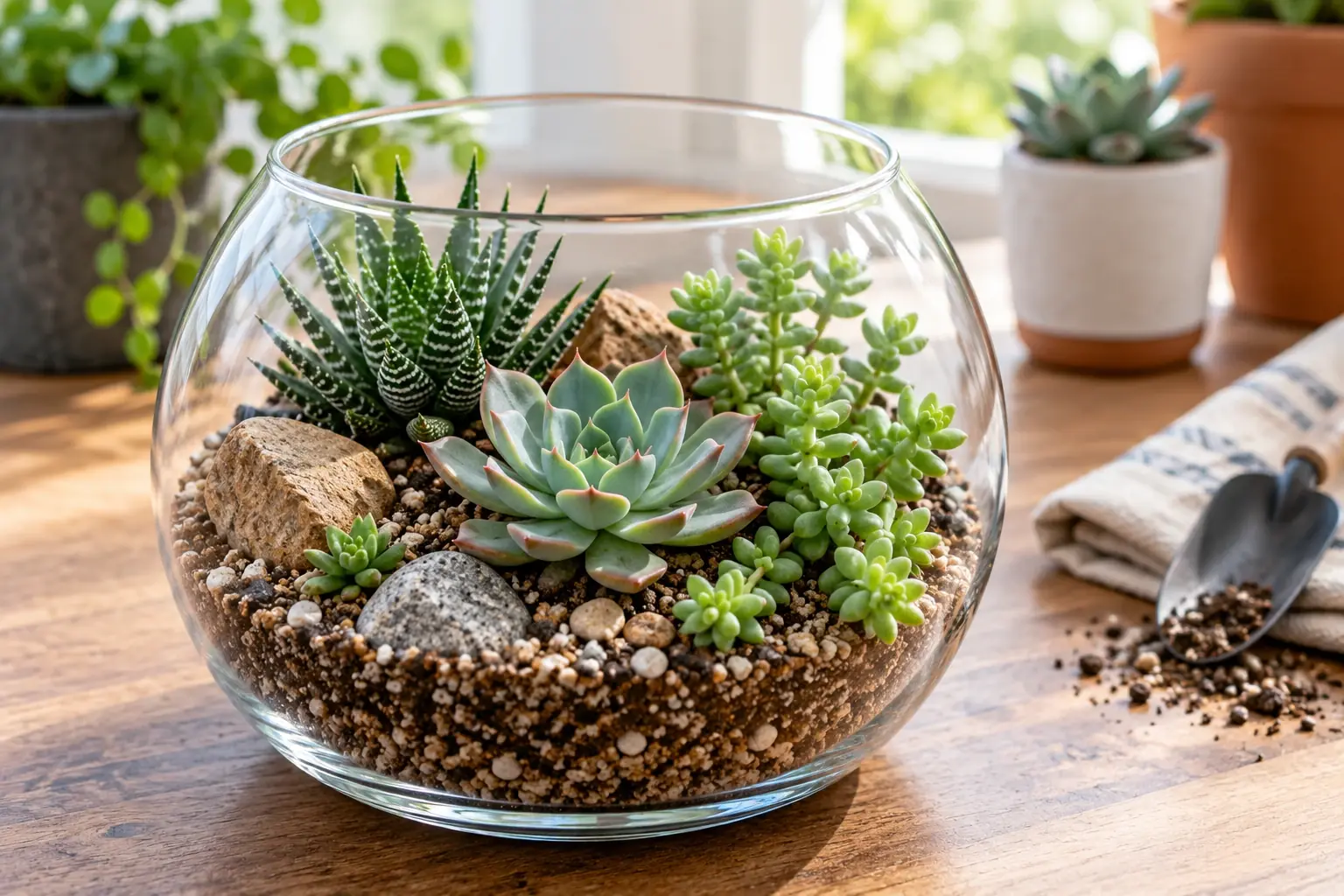
If you’re learning how to make a succulent terrarium, start with an open container, a fast-draining cactus or succulent mix, small plants with similar needs, and careful watering. Succulents store water in their leaves and stems, so they do best when the soil can dry out rather than stay damp.
A closed terrarium is usually a poor fit for succulents. Penn State Extension recommends saving drought-tolerant plants such as Aloe, Echeveria, and Sedum for open terrariums or dish gardens. The lower humidity and faster drying are much closer to what these plants need.
For a first build, keep it simple. Choose two or three small succulents, leave open space between them, and make sure the container gets enough light.
Succulent Terrarium Supplies at a Glance
| Item | Need It? | Why |
|---|---|---|
| Open clear container | Yes | Lets moisture escape and gives you a view of the plants |
| Small compatible succulents | Yes | Choose plants with similar light and watering needs |
| Cactus or succulent potting mix | Yes | Dries faster than ordinary potting soil |
| Small spoon or planting tool | Helpful | Makes it easier to place soil and roots |
| Small watering bottle or dropper | Helpful | Helps control water in a container without drainage |
| Pebbles or decorative stones | Optional | Adds appearance but does not replace real drainage |
Which Succulents Are Best for a Terrarium?
The best choices are small succulents that stay compact, need strong light, and can dry out between waterings. Do not choose plants only because they look good together. They also need similar light and watering needs.
Good beginner possibilities include small Haworthia or Haworthiopsis, compact Echeveria, some small Sedum varieties, and selected small Aloe plants.
Haworthia and Haworthiopsis are useful in indoor displays because many stay compact and tolerate bright indirect light. NC State Extension describes Haworthia as small, drought-tolerant succulents that prefer well-drained potting mix and should dry between waterings.
Echeveria forms neat rosettes and works well in shallow containers, but it usually wants stronger light. NC State notes that overwatering is one of the most common problems with Echeveria.
Sedum can add a lower or trailing shape, but choose a small variety and check its mature size. Some Sedum spread quickly or need more outdoor-level sun than a normal room can provide.
Aloe can work in an open display, but many species eventually get too large for a small glass container. If you use one, choose a compact plant and give it room to grow.
Avoid mixing succulents with ferns, live moss, fittonia, or other plants that want constantly moist soil and higher humidity. One container should have one basic moisture plan.
| Succulent | Why It Can Work | What to Watch |
|---|---|---|
| Small Haworthia / Haworthiopsis | Compact and often handles bright indirect light well | Let the mix dry between waterings |
| Compact Echeveria | Neat rosette shape and stays fairly low | Usually needs stronger light and is easy to overwater |
| Small Sedum varieties | Can add low or trailing growth | Some spread quickly or need very bright light |
| Small Aloe varieties | Drought tolerant and suited to open displays | Many Aloe eventually outgrow a small container |
Should a Succulent Terrarium Be Open or Closed?
Use an open terrarium.
Closed terrariums trap humidity and slow water loss. That works for mosses and many tropical plants, but it works against succulents, which need their growing mix to dry between waterings.
Penn State Extension says succulents and cacti do not make good closed terrarium plants. University of Missouri Extension gives the same basic warning: moist terrarium conditions can promote rot in succulents and cacti.
An open glass container is better because moisture can escape. A shallow dish garden is even easier to manage because more of the soil surface is exposed to normal room air.
If you already have a glass container with a lid, you can still use it. Just leave the lid off when growing succulents.
How to Make a Succulent Terrarium Step by Step
1. Choose an Open Container
Start with a clear container that stays open at the top. A wide opening is better than a narrow neck because it lets moisture escape and makes planting easier.
A container with a real drainage hole is the safest choice for succulents. Illinois Extension calls bottom drainage critical because it lets excess water leave the root zone.
Many decorative glass terrariums do not have holes. You can still use one, but it gives you much less room for watering mistakes. For a broader guide to this container style, see our guide to making an open terrarium.
2. Clean the Container
Wash the container with warm, soapy water, rinse it well, and let it dry.
Starting clean helps keep old soil, algae, and other unwanted material out of the new planting.
3. Add Fast-Draining Succulent Mix
Use a potting mix labeled for cacti and succulents. These mixes hold less water and drain faster than ordinary indoor potting soil.
You can also improve drainage with mineral materials such as perlite, pumice, or coarse sand. The exact mix can vary by plant, so a packaged cactus or succulent mix is the simplest option for beginners.
Do not use heavy garden soil. It can stay wet too long and compact around the roots.
4. Skip the Fake Drainage Layer
You do not need a thick layer of rocks under the soil to “drain” a glass container.
Illinois Extension notes that water does not simply move from fine potting mix into a coarse rock layer underneath. The soil can become saturated before water moves into that lower layer.
If you like the look of pebbles, use them as decoration. Do not treat them as a replacement for a drainage hole or careful watering.
5. Arrange the Succulents Before Planting
Set the nursery pots beside or inside the container before removing the plants.
Put the tallest plant toward the back or center, then place smaller rosettes or trailing plants around it. Leave open space between them. A new succulent terrarium should not look packed on day one.
Also think about mature size. A two-inch nursery plant can become much larger than the glass container.
6. Plant at the Same Depth
Remove each succulent from its nursery pot and gently loosen extra potting mix from around the outside of the root ball.
Make a hole in the new mix and place the plant so the base sits at about the same depth it was growing before. Do not bury the leaves or crown.
Firm the mix lightly around the roots without packing it into a hard mass.
7. Add Simple Decorations
After planting, you can add a few stones, gravel, or a small piece of dry hardscape.
Keep decorations simple and leave some soil surface exposed so you can see and feel whether the mix is dry.
Avoid live moss in a succulent setup. Moss usually wants much more moisture than the succulents do.
8. Water Carefully
If your container has a drainage hole, water according to the plants’ needs and let excess water drain away.
If your glass container has no drainage hole, be much more conservative. Add a small amount around the root zone, then wait until the mix is fully dry before adding more.
Do not water by the calendar. Temperature, light, plant size, soil mix, and container shape all affect how fast the soil dries.
9. Give the Plants Enough Light
Succulents generally need more light than moss and fern terrariums.
Many Echeveria and Sedum varieties need very bright light and may stretch if the room is too dim. Haworthia and Haworthiopsis often handle bright indirect light better.
Watch the plants. If stems stretch, leaves become pale, or rosettes open and lean toward the window, the plants may need stronger light.
A grow light can help when natural light is not enough.
What Soil Should You Use in a Succulent Terrarium?
Use a fast-draining cactus or succulent potting mix.
Illinois Extension recommends a growing medium made for cacti and succulents because overly moist soil is a major cause of root rot. University of Minnesota Extension also recommends porous, sandy growing media for cacti and succulents.
The key is not a magic ingredient. The goal is a mix that lets air reach the roots and dries between waterings.
Perlite, pumice, and coarse sand can improve drainage. Ordinary heavy garden soil is a poor choice because it can stay wet and compact.
If your container has no drainage hole, the growing mix matters even more because extra water cannot escape through the bottom.
Can You Grow Succulents in a Closed Terrarium?
You can put a succulent in almost any container, but a closed terrarium isn’t a good long-term setup.
The lid traps humidity and keeps the soil wet longer. That raises the risk of root rot and weak growth.
Penn State Extension specifically recommends succulents for open terrariums rather than closed ones. If you want to use a lidded glass jar for the look, leave the lid off and treat it as an open terrarium.
This is one of those cases where the right answer is simpler than trying to make the wrong environment behave differently.
How Do You Water a Succulent Terrarium Without Drainage Holes?
Carefully and less often than you think.
A container without a drainage hole cannot release extra water. That means the usual advice to soak the soil until water runs out the bottom does not work.
Let the potting mix dry completely before adding water again. Then add a small amount around the root zone instead of flooding the entire container.
Watch the bottom of the glass. If you see standing water, don’t add more.
The safest option is still a container with drainage. If you repeatedly struggle with wet soil in a no-hole glass container, move the plants to a container that drains rather than keep fighting the same problem.
How Do You Care for a Succulent Terrarium?
Keep the care routine simple.
Give the plants enough light. Most succulents need a bright location, and some need direct sun or a grow light to stay compact.
Let the growing mix dry between waterings. Illinois Extension warns that overly moist soil is a leading cause of root rot in succulents.
Do not fertilize heavily. Fast, soft growth isn’t useful in a small glass container, and succulents generally don’t need frequent feeding.
Remove dead leaves that collect around the base of the plants. Check occasionally for mealybugs, especially in tight spaces between leaves.
Most important, watch how the plants respond. A terrarium near a sunny window may dry much faster than the same container in a cooler room.
For a broader look at watering, lighting, and maintenance, see our guide on how to care for a terrarium.
Why Are the Succulents in My Terrarium Rotting?
Check for too much moisture first.
Illinois Extension describes overly moist soil as a major cause of succulent root rot. Penn State notes that root rot can cause blackened, mushy roots and wilting.
Common reasons a succulent terrarium stays too wet include:
Using a closed container
Watering before the soil has dried
Using heavy potting soil
Growing in a container with no drainage hole
Keeping the plants in weak light where the soil dries slowly
Crowding plants so tightly that air movement is poor
If a succulent has yellow, soft, or mushy leaves, stop adding water and inspect the plant and soil. If the roots are black and mushy, the plant has serious root damage.
A mildly overwatered plant may recover after the soil dries. A badly rotted plant may need to be removed so it does not keep breaking down in the container.
Do not solve every problem by adding water. With succulents, more water is often the problem rather than the cure.
Common Succulent Terrarium Mistakes
Using a closed container. High humidity and slow drying are poor conditions for most succulents.
Mixing succulents with tropical plants. They want different moisture levels.
Assuming gravel fixes drainage. Rocks under the soil do not replace a drainage hole.
Watering on a schedule. Check the soil first.
Choose plants that need different light levels. One plant may stretch while another burns.
Packing the container too tightly. Leave room for growth and airflow.
Using heavy soil. Choose a cactus or succulent mix.
Keeping the terrarium in weak light. Many succulents stretch and turn pale when light is too low.
The Bottom Line
Learning how to make a succulent terrarium is mostly about keeping the setup dry enough. Use an open container, fast-draining soil, small compatible succulents, and careful watering.
For the easiest care, choose a container with a drainage hole. If you use decorative glass without drainage, add water sparingly and let the mix dry fully before watering again.
Do not put succulents in a sealed terrarium. Give them the brighter light, lower humidity, and drier root zone they need, and the display will be much easier to maintain.
Until next time.

Browse more Terrarium guides.
Sources and Further Reading
- Penn State Extension – Creating a Closed Terrarium
- University of Missouri Extension – Terrariums
- Illinois Extension – Stepping into the World of Succulents
- Illinois Extension – Build a Terrarium During the Holidays
- Illinois Extension – Container Drainage Options
- University of Minnesota Extension – Cacti and Succulents
- NC State Extension – Haworthia
- NC State Extension – Echeveria
- Penn State Extension – Pest and Disease Problems of Indoor Plants