Mold in an isopod enclosure is a reason to inspect the habitat, not to dry out the whole colony. Remove moldy supplemental food carefully, check for overly wet areas and poor airflow, and watch whether growth stays local or returns. Isopods still need suitable moisture and shelter while you address the problem.
A fuzzy patch on yesterday’s snack can look alarming. Before emptying the enclosure, find out where the growth begins and how far it extends. A single spoiled food item and repeated growth across several areas call for different levels of attention.
Start With Where the Mold Is Growing
Look before stirring or removing anything. Take a photo if you want to compare the patch later. Check nearby leaves, the feeding spot, and the surface beneath a removable hide without turning the whole habitat upside down.
| Where you see growth | What to check first |
|---|---|
| On a leftover vegetable or protein food | How much you offered, how long it has been there, and whether pieces fell into the substrate. |
| On one leaf, wood piece, or feeding surface | Whether it is confined to that item or also appears on nearby material. |
| Across several areas or repeatedly after removal | Recent feeding and watering changes, substrate wetness, and whether vents are clear. |
These are starting points for inspection, not diagnoses. A new piece of wood may be the place you first notice growth, but that alone does not prove the wood introduced it. Mold spores occur widely in the environment; finding a patch does not automatically mean you bought a bad product.
Remove Affected Material With the Residents in Mind
Carolina Biological Supply recommends removing moldy food or material, and Portland Insectarium also advises taking out moldy fruit and vegetables. For a loose food scrap or affected leaf, check underneath it, gently move any animals off, and lift it out. Keep removed material contained while you check for hidden young.
If an affected hide is providing important cover, prepare suitable replacement shelter before removing it. Avoid shaking or brushing growth through the enclosure. Wash your hands after handling the habitat, and do not lean in to sniff a patch for identification.
Our guide to cleaning an isopod enclosure covers careful sorting and substrate renewal. A local patch does not automatically require a complete rebuild. If affected material extends through much of the substrate, assess the whole setup and get species-specific help before planning a larger move.
Check Food, Water, and Airflow Together
Food is often the easiest thing to adjust. If supplemental portions repeatedly spoil before the colony finishes them, offer less next time and inspect the feeding spot more closely. Keep suitable leaf litter available rather than withholding the animals’ basic food supply.
The breeder at springtails.us places supplemental food on the drier side and offers only what the colony can finish before it spoils. That is a useful option to consider, not a reason to turn the entire habitat dry. The guide also stresses that ventilation needs vary with species and local conditions.
Check the substrate before adding more water. Preserve a suitable damp refuge while avoiding saturation. A routine misting habit can miss what the enclosure needs today; inspect the actual material rather than watering simply because the spray bottle is in your hand.
Carolina’s mold guidance recommends improving ventilation. Start by checking that existing vents are not blocked. If the enclosure needs changes, plan secure ventilation suited to the species and monitor drying afterward. Removing the lid indefinitely or adding a fan can create another problem: a habitat that loses moisture too quickly.
White Mold Is a Description, Not an Identification
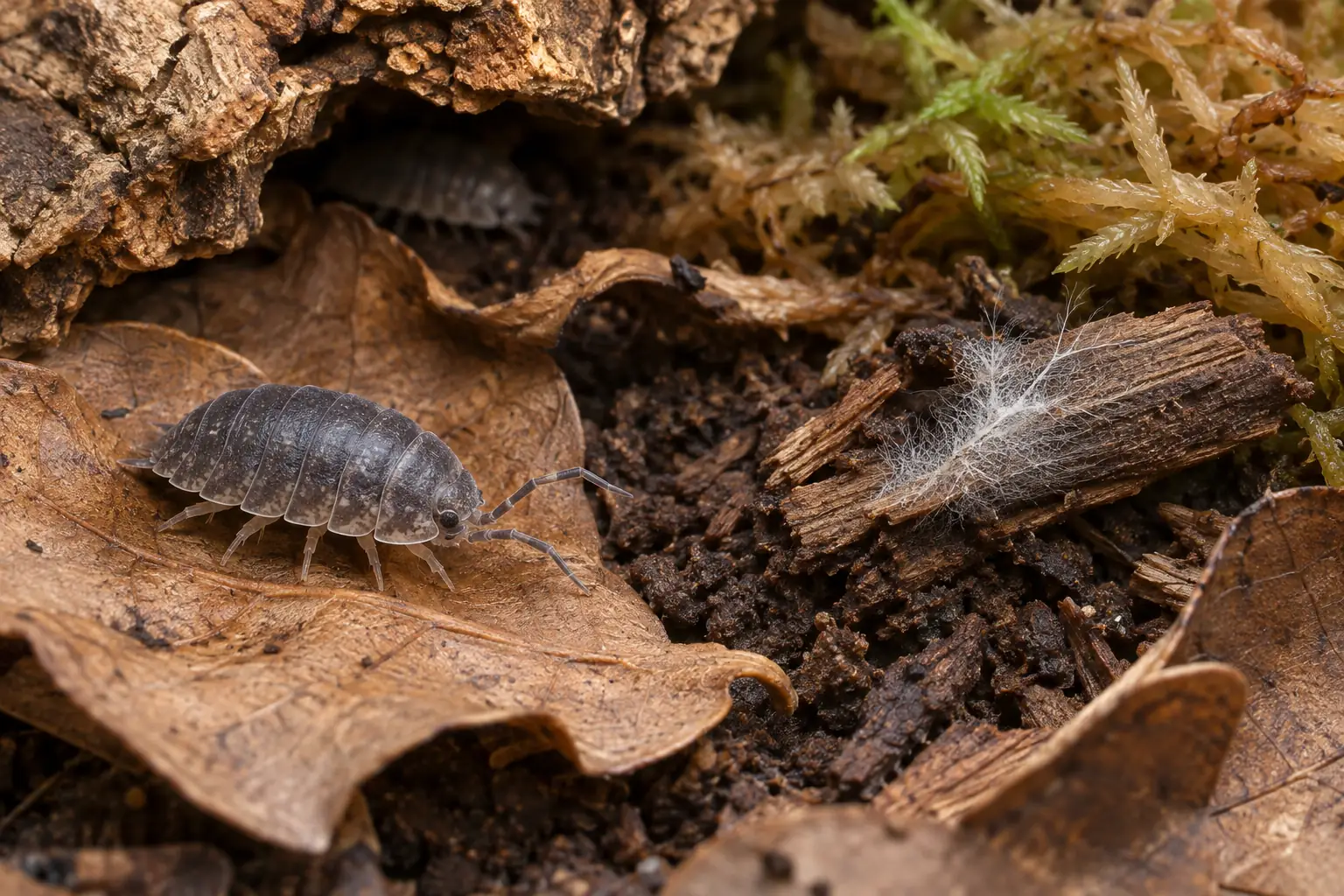
White mold in an isopod enclosure may appear as fuzz or fine threads on food, wood, or substrate. Its pale color does not establish which fungus it is or whether it is harmless. A photograph can document what you see without providing a firm identification.
The EPA explains that molds come in many colors, including white, and that looking at a mold cannot tell you whether it is producing toxins. That is general information about fungi, not an isopod treatment guide. It supports a modest conclusion: do not use color as a safety test.
Avoid bringing plant-only terrarium remedies into an occupied animal enclosure. Do not apply household mold remover, bleach, peroxide, or an unverified fungicide recipe around the colony. Start with careful removal and habitat checks; seek specific advice if those steps do not resolve the concern.
Do Isopods Eat Mold? Sometimes, but They Have Preferences
Isopods can eat fungi, but that does not mean they will clear every fuzzy patch. One research project approached this question through an unlikely setting: stored potatoes. Researchers wanted to know whether woodlice might help control a fungus that spoils the crop.
In a laboratory feeding trial reported in Agriculture’s 2022 volume, Porcellionides pruinosus was offered four fungi. The animals consumed much more of Sclerotinia sclerotiorum, while largely avoiding Aspergillus niger. Survival was also poorer on the latter treatment. The researchers suggested a possible toxin explanation, but did not establish it as the cause.
The useful lesson for a keeper is that fungi are not interchangeable. This experiment does not identify the patch in your enclosure or prove that every pet isopod reacts the same way. Seeing an animal graze nearby is not a reason to leave spoiled food in place or stop checking conditions.
Springtails Can Help Without Taking Over the Job
University of California IPM describes springtails feeding on fungi, molds, algae, and decaying plant material. That diet helps explain their popularity as companions in suitable isopod setups. It does not promise that adding a cup of springtails will erase an outbreak.
If springtails are already present, keep checking the same things: food portions, moisture, and ventilation. Their presence is not proof that conditions suit the isopods. Nor should you add extra food just to increase springtail numbers while uneaten portions are already causing trouble.
Choose any new companions for compatible care needs, not simply because a seller calls them a cleanup crew. Household advice about eliminating springtails by drying out a room is not a care method for a deliberately inhabited enclosure.
If Mold Keeps Coming Back, Record the Pattern
Repeated growth is a reason to revisit the conditions, not just repeat the same removal. Keep a short record so you can describe what is happening to the supplier or an experienced keeper:
- Where growth appears, whether it returns on the same material, and whether it is spreading.
- Recent foods, new leaves or wood, watering changes, and any changes to the lid or ventilation.
- The isopod species, damp and drier areas, and any unusual behavior or deaths noticed during normal care.
Seek help promptly if growth is widespread or keeps returning despite adjustments, especially alongside losses. Do not assume mold caused a death just because both appeared together. Avoid changing food, ventilation, substrate, and temperature all at once without a clear reason; that makes the result harder to understand.
A useful check afterward is more than “the fuzz is gone.” Has new growth slowed? Are food portions being finished? Is the damp refuge still suitable? The aim is a habitat you can maintain confidently, with its small residents still comfortably at home.
Until next time.

Browse more guides in our Isopods category.
Sources and Further Reading
- Carolina Biological Supply — Care Guide: Terrestrial Isopods
- Portland Insectarium — Isopod Care
- springtails.us — Isopod Care Guides
- US EPA — Introduction to Molds: Growth, Color, and Identification Limits
- Mészárosné Póss and colleagues (2022) — The Spread of the Soil-Borne Pathogen Fusarium solani in Stored Potato Can Be Controlled by Terrestrial Woodlice (PDF)
- UC Statewide IPM Program — Springtails: Habitat and Feeding