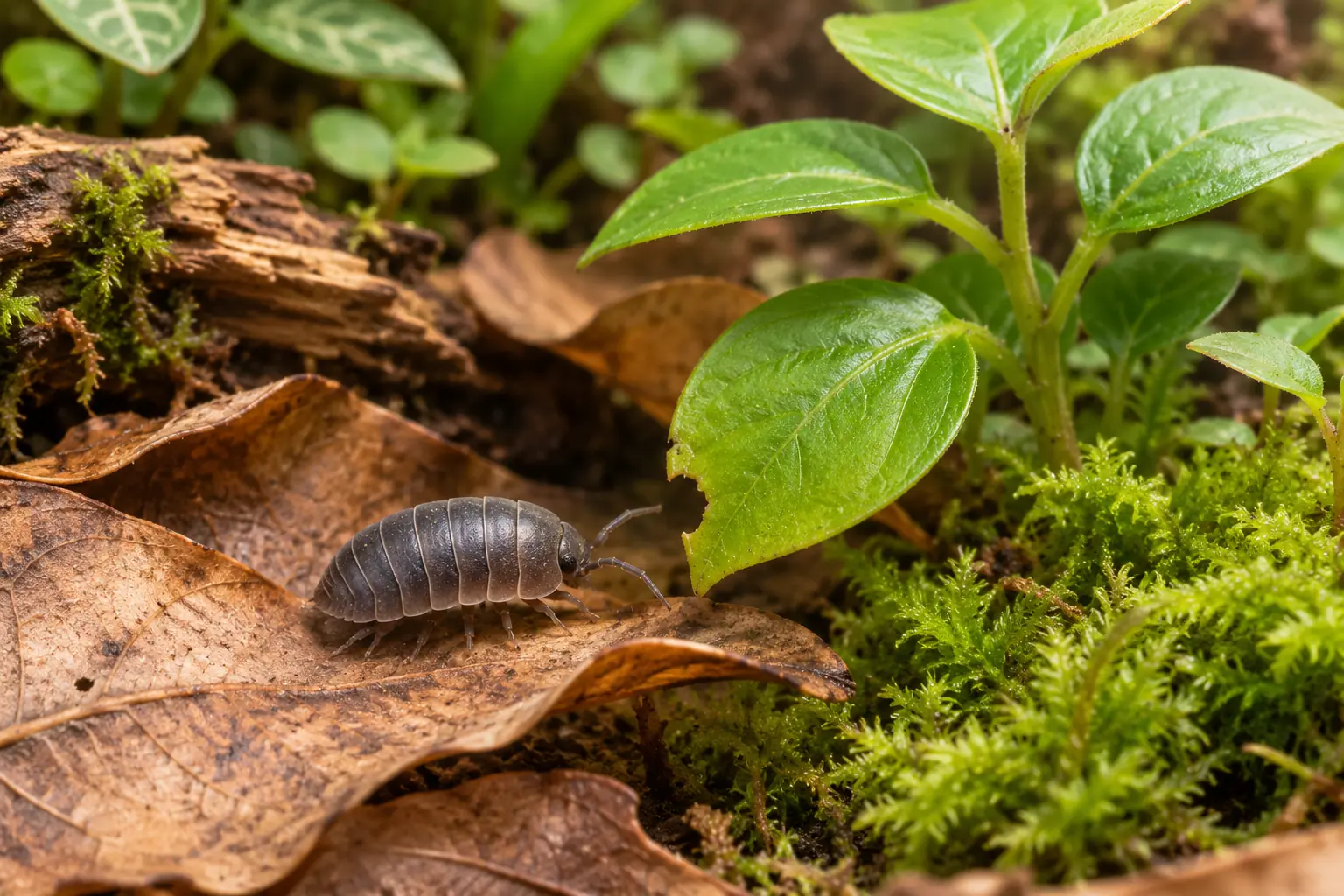
Do isopods eat plants in a planted enclosure? They can, including living tissue, even though decaying plant material is their main food. Tender growth, seedlings, and moss deserve attention. But finding an isopod beside a damaged leaf does not prove it caused the damage.
You added a cleanup crew, and now you would rather it didn’t eat the scenery. Before moving every animal or replacing every plant, find out what is disappearing and whether you can see the feeding happen.
Dead Leaves Are the Main Course, Not the Whole Menu
The University of California’s IPM guide describes pillbugs and sowbugs as mainly eating decaying plants. It also records occasional feeding on seedlings, new roots, lower leaves, and soft plant parts. A living leaf does not have to turn brown before an isopod can take a bite.
This ability has been tested. In a 2017 study, Josh Douglas and colleagues combined a feeding trial with field reports and found that Armadillidium vulgare could damage several kinds of crop seedlings. The study’s abstract establishes that living plants can be food; it does not tell us which terrarium plants every pet isopod will leave alone.
That distinction matters when choosing a colony. A species name or a seller’s “cleanup crew” label cannot promise spotless foliage in your particular enclosure. Treat tiny seedlings and fresh, soft growth as things to watch closely, rather than assuming only dead material is at risk.
Find the Diner Before Blaming the Damage
A useful lesson comes from researchers who watched fields after dark. South Australia’s SARDI Entomology team used infrared cameras to record animals around seedlings in six fields during 2021 and 2022. Woodlice, called slaters there, were rarely seen damaging the seedlings; other animals, including earwigs, were more active feeders.
That trial did not clear all isopods of plant eating. The slaters reported at the site where they were abundant were Australiodillo bifrons, and the researchers noted that they might have missed other species or conditions that encourage feeding. Its useful lesson for a keeper is simpler: an animal near damage may be eating tissue that was already damaged.
You do not need a research camera to take a closer look. Photograph the affected leaf while it is still attached, then compare the same spot during later checks. Briefly watch the enclosure when the animals are active, including after the room gets dark. Look for tissue actually being removed, rather than counting animals nearby.
| What you notice | What to check next |
|---|---|
| An isopod on an old brown leaf | Was that tissue already dead? Feeding here fits the cleanup role. |
| A new gap in a green leaf | Compare dated photos and watch the edge. The gap alone cannot identify its cause. |
| A thinning patch of moss | Look for grazing or disappearing shoots. Color change alone does not establish feeding. |
Keep the inspection gentle. Repeatedly digging around roots or lifting the whole planting adds disturbance without showing who made a hole. If a prized plant is losing fresh growth quickly, protect it in a separate suitable growing space while you investigate; you do not have to wait for perfect evidence before preventing more loss.
Living Moss Can Be on the Menu Too
Moss is not guaranteed to remain untouched. In her isopod care guide, breeder Laura Mae Riepl reports animals eating live, dead, and rehydrated moss. That is a keeper’s observation, not a controlled comparison of every moss and isopod species, but it is enough reason to monitor a living moss carpet.
Also separate two different uses of the word “moss.” Dried sphagnum placed in a moist refuge is habitat material. A living green cushion that you want to keep growing is part of the planting. The same expectations do not apply to both.
If the living cushion turns brown, do not automatically call it an isopod problem. Check its growing conditions and whether plant material is actually disappearing. If you watch animals removing fresh shoots, you have stronger evidence. If the shoots remain present but lose color, look beyond feeding before changing the colony.
Protect the Planting Without Shortchanging the Colony
Start with a dependable supply of suitable leaf litter and soft decayed wood. A display full of living plants still needs food for its isopods; decorative greenery is not a substitute. Our isopod feeding guide covers that food base and sensible supplements without turning the enclosure into a bowl of leftovers.
Treat adequate feeding as basic care, not a guarantee that living plants will be ignored. Adding more vegetables is not proof that you have solved the problem, and leaving piles of uneaten food creates another job. Watch what the colony consumes and remove spoiling extras.
For plants you especially want to protect, use a few practical limits:
- Grow tiny seedlings and delicate new cuttings separately while they establish. More growth gives a plant more to lose, but does not make it bite-proof.
- Try an easily replaced plant before adding a prized specimen. Record its condition when it enters the enclosure so old damage is not mistaken for new feeding.
- Do not count on a small pot inside the enclosure to keep isopods out. If access must stop, use a separate suitable container.
- If fresh losses continue, separate the planting and colony rather than repeatedly replacing the same vulnerable growth.
Keep the animals’ needs intact during any change. Drying out their moist refuge or stripping away their leaf litter to protect a plant undermines their habitat. Garden advice about discouraging woodlice has a different goal from caring for a colony you intend to keep.
Decide What You Want This Enclosure to Do
A planted isopod enclosure does not have to look untouched to be enjoyable. You may be happy with occasional nibbles if plants keep producing new growth and the animals are doing well. Watch the overall trend: a few stable marks are different from fresh leaves disappearing as fast as they appear.
If the goal is a carefully shaped moss garden or a collection of treasured plants, separate housing may be the better choice. Give the isopods their own suitable enclosure and enjoy their leaf-shredding work there. You can appreciate both hobbies without requiring every animal and plant to share an address.
The useful discovery is what your own colony does with your own planting. A dated photo, a quiet look after dark, and a clear idea of what you want to preserve can tell you more than blaming the first little gray animal you see.
Until next time.

Browse more guides in our Isopods category.
Sources and Further Reading
- University of California IPM — Pillbugs and Sowbugs
- Douglas and colleagues (2017) — Crop Seedling Susceptibility; abstract in FAO AGRIS
- SARDI/PIRSA — Paddock Trial Demonstrates Importance of Monitoring (May 5, 2023)
- Laura Mae Riepl, Smug Bug — Isopods: Basics of Care (PDF)