
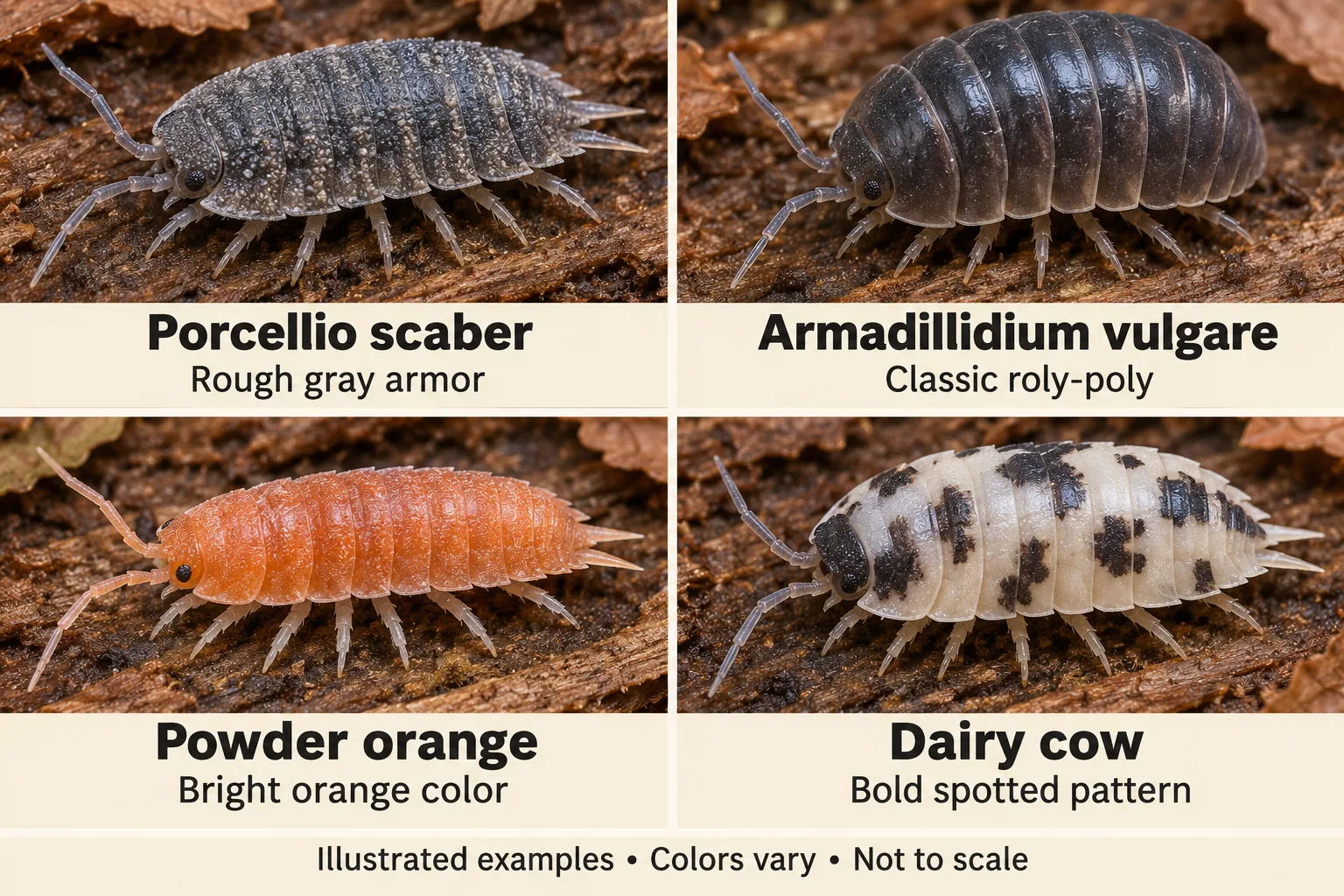
The best isopods for beginners include Porcellio scaber, Armadillidium vulgare, powder orange isopods, and dairy cows. Each offers a different attraction, from the familiar roly-poly shape to bright color or busy feeding. Start by choosing the kind of colony you want to observe, then check that you can meet its needs.
A striking photograph can start the interest. It cannot tell you how much food a growing colony will use, how often the animals will hide, or whether their conditions suit your home. Those are the details that turn a good-looking isopod into a good first pet.
Which Beginner Isopod Fits You
This shortlist is for a colony kept as pets in its own enclosure. Choosing a cleanup crew to live with another animal requires a separate compatibility check. Care comparisons draw on published husbandry guides and keeper experience; activity and colony growth will vary with conditions.
| Starter choice | Why consider it | Main tradeoff |
|---|---|---|
| Porcellio scaber | An adaptable starter with many color varieties | A successful colony can become a busy feeding and maintenance job |
| Armadillidium vulgare | The familiar pillbug that can roll into a ball | Patience matters; do not keep its whole enclosure wet |
| Powder orange | Bright color and quick movement | Fast animals need careful containment; colonies can grow quickly |
| Dairy cow | Larger bodies with bold black-and-white spotting | Strong appetites and colony growth need attention |
If you have no strong preference, Porcellio scaber is a sensible starting point. If the childhood roly-poly is what drew you in, consider Armadillidium vulgare. Color and visible movement may draw you toward powders or dairy cows, but none of these animals will stay on display just because you want a better look.
Porcellio Scaber for an Adaptable First Colony
Porcellio scaber is the common rough woodlouse. Breeder Smug Bug recommends it as a beginner species based on its experience keeping and breeding isopods. Its adaptability and range of color forms make it a useful place to begin comparing options.
The main lesson in Porcellio scaber care is to keep providing a moist retreat alongside ventilation and a drier area. Hardy does not mean an animal can go without suitable conditions.
Scabers can breed readily and eat enthusiastically. That can be rewarding if you want to watch a colony develop, but be prepared for the amount of care to change as numbers grow. Choose them because the ongoing colony interests you, not because the word beginner sounds like no work.
Armadillidium Vulgare for the Classic Roly-Poly
Armadillidium vulgare is a good candidate if you want the rounded pillbug many people recognize from the garden. It can curl into a ball when disturbed. That is a defense response, so there is no need to keep nudging one to make it perform.
For Armadillidium vulgare care, pay attention to the balance between a damp refuge and a drier part of the enclosure. A beginner can reasonably hear moisture and imagine that wetter must be better. The useful goal is a choice of conditions, not a permanently soaked home.
Smug Bug reports slower reproduction in common Armadillidium than in the Porcellio and powder isopods it compares. Treat that as a broad keeper observation, not a calendar. This choice suits someone who enjoys watching familiar little animals without expecting an instant population boom.
Powder Orange for Color and Quick Movement
Powder orange is a color form commonly sold as Porcellionides pruinosus. The same species is also sold in other forms, including powder blue. That orange label tells you about appearance; it does not make the animal a separate species.
Published keeper guides describe powder isopods as active, quick-moving animals that can reproduce rapidly once established. If watching a bright little creature hurry over bark sounds appealing, they deserve a place on your shortlist.
The practical catch is right there in the word quick. Use a secure enclosure, and take care when lifting hides or moving material. Observing a fast isopod is enjoyable; trying to find it on the floor is less charming.
Powder orange isopod care still requires access to a damp retreat, even in a setup with a drier area. Keepers also emphasize food availability as colonies expand. Choose powders if you are comfortable tending a potentially busy colony, rather than expecting a permanently small group.
Dairy Cows for Bigger Spotted Animals
Dairy cows are commonly sold under the name Porcellio laevis. Their pale bodies and dark spots explain the nickname, and their size makes those markings easier to appreciate. They are an appealing option when the animals themselves are the main attraction.
Dairy cow isopod care comes with an appetite to match that appeal. Specialist care guides emphasize their demand for food, including suitable protein supplements, and their ability to build a large colony. A few spotted animals can become a much bigger responsibility.
Plan for that growth before it becomes a problem. You may eventually need more enclosure space or a suitable new home for surplus animals. Keep watching what the colony consumes, rather than continuing the same routine indefinitely.
For a first pet colony, keep dairy cows on their own. Their reputation for eating well is not a reason to put them straight into a delicate animal’s enclosure. That is a different care decision, not a bonus feature that comes with the spots.
Read the Species Name Before the Color Name
Isopod names become less confusing when you separate the scientific name from the variety label. In Porcellionides pruinosus ‘Powder Orange,’ the first two words identify the species as sold; Powder Orange names the color form.
A color morph is a variation in appearance within a species. An orange isopod is not automatically a powder orange, and a spotted isopod is not automatically a dairy cow. Similar patterns occur in different species.
Ask for both the scientific name and the culture or variety name, and keep that information with the enclosure. Some hobby labels have unsettled identification behind them. For example, Smug Bug reports that dairy cows do not cross with other cultures labeled Porcellio laevis. A shared sales label alone does not settle their identity or breeding compatibility.
You do not need to solve isopod classification before enjoying a colony. You do need enough information to find relevant care guidance and to know what you are being offered.
Make the Choice Before Bringing Them Home
Once a candidate appeals to you, work through a few practical questions:
- Can I maintain the conditions this particular culture needs where its enclosure will sit?
- Am I happy to watch animals that may spend much of their time under cover?
- Do I want a quickly growing colony, and what will I do if it outgrows the space I planned?
- Can the supplier explain the animal’s identity and how the colony is currently kept?
Do not copy a ventilation pattern or watering schedule without considering the setup it came from. The keeper behind springtails.us explicitly notes that local climate changes ventilation needs. Instructions that work in one room may need adjustment in another.
Our isopod care guide explains the everyday commitment and basic habitat needs. Use it alongside the care information for your chosen species before adding animals.
In the United States, check USDA APHIS guidance and applicable state requirements before acquiring isopods or arranging shipment. APHIS says many species require a permit. A listing for sale is not confirmation that a particular transaction is allowed.
Choose a Colony You Will Enjoy Watching
You can begin with ordinary-looking scabers and find plenty to enjoy. You can choose orange powders because their color catches your eye. Neither choice needs to impress anyone else.
Pick one identifiable starter colony whose care you can manage, and give yourself time to learn it. The interesting part begins when the photograph becomes a living group with its own hiding places, feeding habits, and changes to notice.
Until next time.

Browse more guides in our Isopods category.
Sources and Further Reading
- Smug Bug — Beginner Friendly Isopods
- Springtails US — Isopod Care Guides
- Josh’s Frogs — Powder Orange Isopods
- The Bio Dude — Powder Isopod Care Sheet
- The Bio Dude — Dairy Cow Isopod Care Sheet
- Smug Bug — Dalmatian Mutation in Different Isopod Species
- USDA APHIS — Invertebrate Pets