
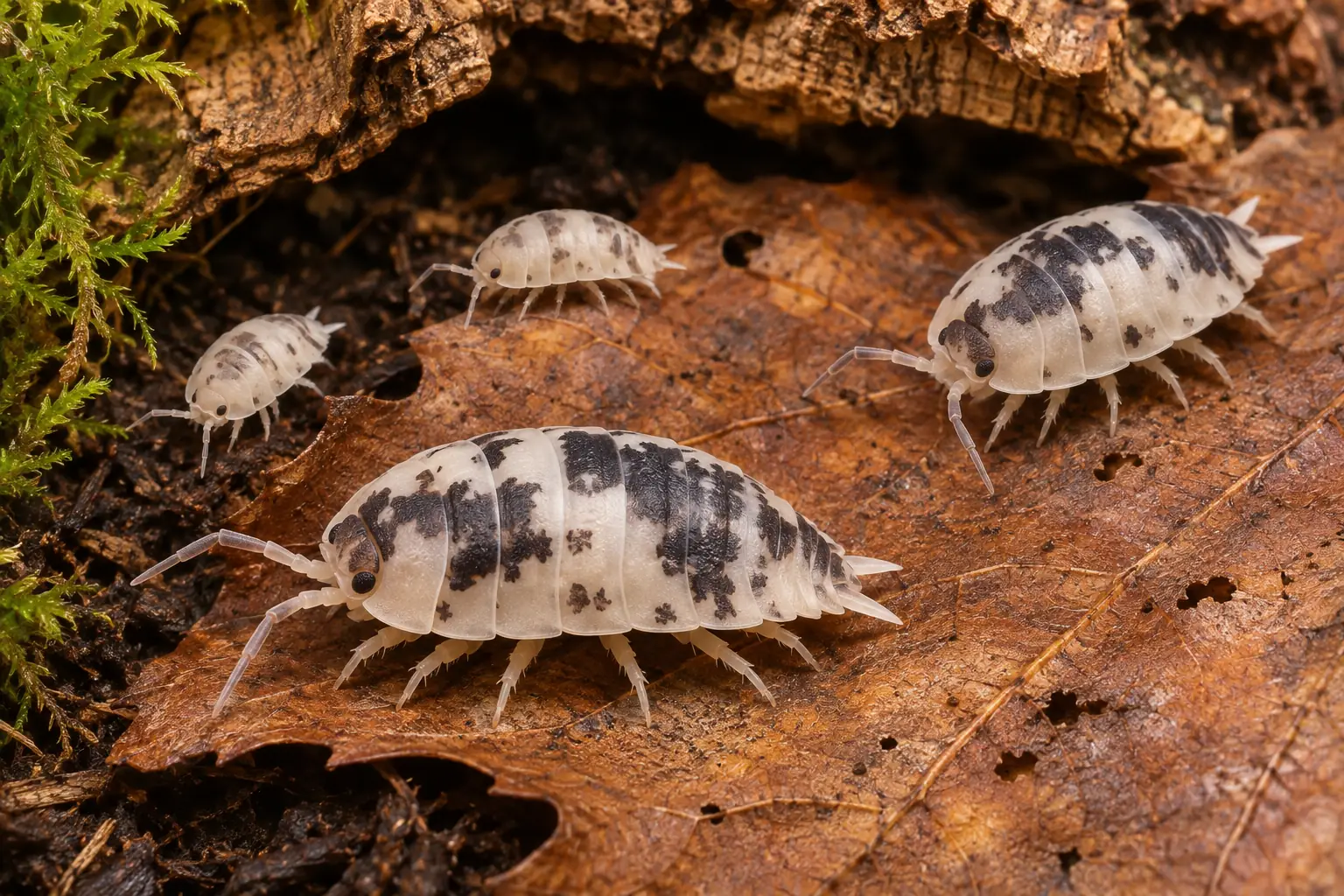
How long do isopods live as pets? Several years is possible for some familiar terrestrial species, but there is no single lifespan for every isopod. The University of California’s guide says adult pillbugs and sowbugs can live two to five years. That broad range is not a guarantee for every animal you buy.
There is also a second clock running in the enclosure. An individual ages and eventually dies, while a reproducing colony can continue through new generations. A colony celebrating its third anniversary is not necessarily full of three-year-old isopods.
Read Lifespan Numbers With Their Limits
Care guides are useful starting points, but check which animals and conditions they describe. SARE’s woodlouse profile says adults can live two or more years. Flinn Scientific’s classroom care guide notes that some species live up to four years. Both support planning beyond a short-lived classroom project. Neither supplies a tested lifespan for every pet species or color form.
Pay attention to the wording, too. A reported maximum is not an average, and a figure for adult survival is not automatically the same as total life from birth. A study of wild animals answers a different question from a record of pets raised in an enclosure.
For choosing a pet, the practical lesson is to plan for an ongoing commitment. For judging one animal’s age, the same broad number is much less useful. It cannot tell you how much life that particular isopod has left.
A Colony Can Outlast Its First Residents
Imagine buying a small starter group and later finding youngsters beneath the leaves. As those young grow, some may reproduce too. Over time, the enclosure can hold animals from several generations, even if you never add another purchased isopod.
That is how a colony can carry on after its founders are gone. It is a continuing population, rather than one permanent set of animals. A keeper saying “I have had these isopods for five years” may mean the culture has been maintained for five years. Without records of individuals, that statement does not establish a five-year lifespan.
Our guide to how isopods reproduce explains where those next generations come from. Here, the important distinction is that a colony’s age and an individual’s age are different pieces of information.
A busy colony is also not proof that every adult is long-lived. New youngsters can keep the enclosure looking active as older residents disappear. Watching the population tells you something useful, but it does not give each animal a birthday.
The Day You Buy Them Is Not Day One
An isopod’s life began before it arrived at your house. A mixed starter group may include young animals and adults with different histories. Unless the breeder has followed a known group from early life, an exact age may be unavailable.
Suppose an adult lives with you for twelve months. You know it survived those twelve months, plus however long it lived before purchase. You do not know its total lifespan just from the arrival date. This is why two keepers can report very different experiences without either giving an accurate birth-to-death figure.
When age or longevity matters to your decision, ask the supplier a few specific questions:
- What scientific name and culture or color-form name come with the animals?
- Will the group contain juveniles, adults, or a mixture?
- Is their age known from a recorded group of young, or estimated from size?
- Does the quoted lifespan come from following individual animals, or from keeping the colony going?
“Age unknown” is a useful, honest answer. Keep it in your notes rather than turning a guess into a precise date.
How Long Do Dairy Cow Isopods Live?
Dairy cow isopods are commonly sold as Porcellio laevis “Dairy cow,” including by breeder Smug Bug. The familiar name makes a simple lifespan figure tempting, but evidence about a wild population should not be treated as a tested lifespan for that pet culture.
In a 2016 study, Chedliya Ghemari and colleagues sampled wild Porcellio laevis in northern Tunisia over eighteen months. They estimated a lifespan of ten to twelve months by analyzing the sizes and apparent age groups in the population. They were not following individually identified dairy cow pets from birth to death.
That finding is valuable, but it is not a deadline for the animals in your enclosure. It also shows why a blanket claim that every isopod lives several years is too broad. The pet name alone does not settle the question.
The sources reviewed here do not establish a reliable average captive lifespan specifically for the dairy cow culture. Ask a breeder whether their estimate is based on known-age animals from that stock. Treat an unsupported number as an estimate, and plan for the colony to need care beyond the lives of its starting adults.
A Large Isopod Does Not Come With a Birth Certificate
Size can help you describe an animal, but a casual size comparison is not a reliable age measurement. Terrestrial isopods can continue growing after they become mature. Adult is not a single final size.
In their 2018 study and review, Andrzej Antoł and Marcin Czarnoleski found a wide size range among reproducing Porcellio scaber females. The smallest and largest mothers were both mature enough to reproduce. That matters when a seller describes an animal as a “breeding adult”: the description tells you about its life stage, not an exact age.
A small log is more useful than repeatedly picking up animals to inspect them. Record the arrival date, supplier, scientific name, whether ages were known, and when you first noticed young. Occasional photographs taken during normal care can help you follow changes without turning the habitat upside down.
Plan for a Living Colony, Not an Expiration Date
Use lifespan estimates to think about the commitment ahead. If the colony breeds, it may need more space, food, and upkeep long after the original group has aged. Decide who will care for it during absences and what you will do if it becomes more than you want to maintain.
Do not use a rough lifespan figure to explain away an unexplained loss. Without a known age, “old age” is a guess. Several deaths close together call for a review of the colony’s conditions; an article about longevity cannot identify their cause.
You do not need to know every birthday to enjoy keeping isopods. Knowing the difference between an animal’s life and a colony’s history gives you better expectations. The small world under the leaves can keep changing, one generation at a time.
Until next time.

Browse more guides in our Isopods category.
Sources and Further Reading
- UC Statewide IPM Program — Pillbugs and Sowbugs
- SARE — Farming with Soil Life: Woodlice
- Flinn Scientific (2016) — Isopod Care Guide (PDF)
- Ghemari and colleagues (2016) — Population Structure and Dynamics of Porcellio laevis in Northern Tunisia
- Smug Bug — Porcellio laevis “Dairy cow”
- Antoł and Czarnoleski (2018) — Size Dependence of Offspring Production in Isopods