
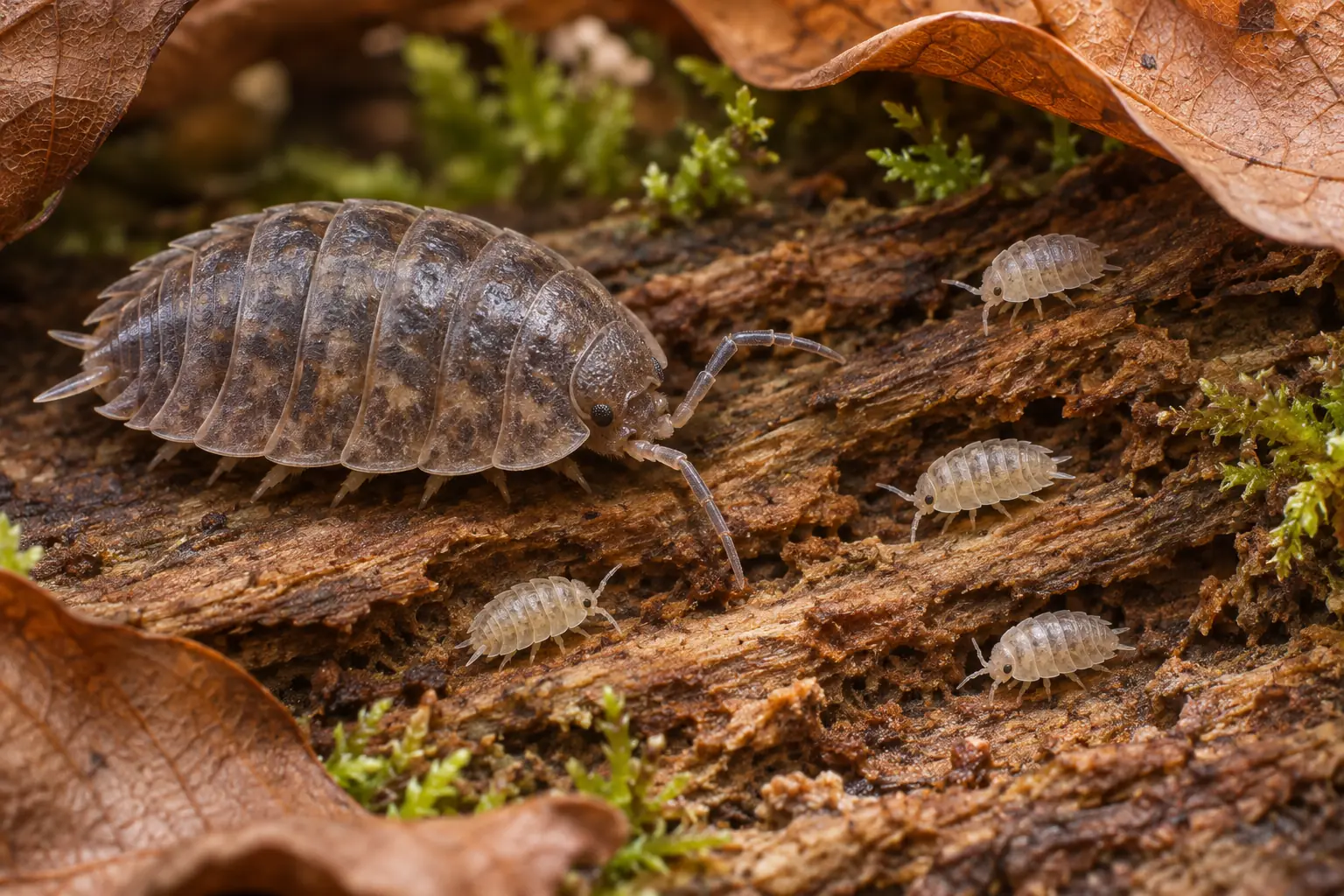
How do isopods reproduce when you never see eggs in the enclosure? In most terrestrial species, males and females mate, and the female carries eggs in a brood pouch beneath her body. The eggs hatch there, and the young stay inside as they develop before emerging.
The nursery travels with the mother. That helps explain why a colony can seem unchanged until tiny, pale isopods suddenly appear among the adults. Much of the work happened out of sight.
The Brood Pouch Is More Than an Egg Carrier
The pouch is called a marsupium. Plates on the female’s underside form it during a molt associated with reproduction. Inside, developing young have a sheltered environment that begins with fluid rather than open air. This portable nursery helped isopods make the move to life on land.
So isopods both lay eggs and release living young. Those statements fit together because hatching happens inside the pouch. You should not expect a normal brood to appear as a clutch of eggs scattered across the soil.
A female carrying eggs or young may be described as gravid. You might glimpse the pouch when she moves where her underside is visible, but there is no need to flip her over repeatedly to check progress. Leave her shelter in place and let an ordinary care check remain ordinary.
Most Need Mates, but There Are Exceptions
For familiar sexually reproducing species, a breeding colony needs mature males and females. Fertilization is internal. Having two animals is not enough by itself: they might be the same sex, still immature, or different species.
Some females can retain sperm from earlier mating. A female moved away from males may therefore produce young later. In a laboratory study of Porcellio siculoccidentalis, researchers recorded successive broods without further mating. Babies appearing after a move do not necessarily mean mating happened in the new enclosure.
Dwarf white isopods, Trichorhina tomentosa, offer another surprise. Steve Gregory’s account in the British Myriapod & Isopod Group bulletin describes this species as reproducing by parthenogenesis: females produce offspring without males. That exception belongs to the species; it is not how every isopod colony works.
How Many Isopods Should You Start With?
A group is a more practical starting point than an unsexed pair. In her care guide, breeder Laura Mae Riepl recommends ten or more as a starting group. Treat that as a keeper’s useful guideline, not a biological minimum or a guarantee of breeding.
The group’s makeup matters as much as its head count. Ask the supplier whether the animals are juveniles or adults and, for a species that needs mates, whether both sexes are represented. Ten youngsters still need time to mature. Buying more animals cannot fix unsuitable housing.
Before trying to increase numbers, make sure the existing animals are doing well. Our isopod care guide covers the foundation: an identified species, suitable habitat, food, and regular observation. Breeding should grow out of that care, rather than become a reason to keep changing the enclosure.
Baby Isopods Still Have Some Growing to Do
The early young are called mancae; one is a manca. They resemble small, often pale adults, but their development is unfinished. Early mancae have six working pairs of walking legs. The seventh pair develops as they grow and molt. Six pairs means twelve legs, so these babies have not briefly turned into insects.
The first moments outside can be quiet. In the Porcellio siculoccidentalis study, newly released young stayed beneath or near the female until their first molt, then began exploring and searching for food. That is an observation from one species, not a schedule to impose on every brood.
For routine colony care, make the habitat usable by small animals instead of treating every baby as a separate project:
- Keep suitable leaf litter and decayed material available near shelter, so tiny youngsters can reach food without crossing a bare enclosure.
- Maintain the species’ damp refuge and ventilation. Do not let the refuge dry out while the rest of the enclosure still looks moist.
- Lift and replace hides carefully, checking for youngsters beneath the edges. Inspect material before removing it from the enclosure.
- Keep supplemental portions modest and remove spoiling leftovers. More babies do not automatically call for a large pile of extra food.
Use a close photograph or magnifier if you want a better look. A tiny pale dot alone is not enough to identify a baby isopod; look for the segmented body and recognizable shape. You do not need to collect the whole brood to enjoy finding it.
Support Breeding Without Chasing a Deadline
There is no honest countdown that works for every species and starter group. Age, mating history, conditions, and the species’ own breeding pattern all affect expectations. Ask the breeder what is typical for that particular culture and what ages you are receiving.
Brood size varies too. In their 2018 study and research review, Andrzej Antoł and Marcin Czarnoleski found that larger females generally produced more offspring in the isopods examined. A brood count from one female is not a promise of what every female will produce.
If you see no babies, work through the basics before adding equipment or more animals. Confirm the species, whether the animals are mature, and whether mates are present when needed. Check food access, the damp refuge, ventilation, and actual enclosure temperature against that species’ requirements. Hidden young are another possibility; absence during a quick glance is weak evidence.
Do not turn up the heat simply to race a breeding timetable. Keep conditions suitable and stable, and note when you first see young during normal care. Over time, seeing those youngsters grow gives you more useful information than repeatedly searching for a full pouch.
Make Room for the Next Generation
The first babies are exciting. The next few broods are a reminder that you are keeping a population, not a fixed set of pets. Watch whether food disappears faster, suitable shelter stays available, and routine upkeep is becoming harder.
Plan another suitable enclosure or a responsible new keeper before the colony becomes more than you can manage. Splitting a colony gives you more room, but it also creates another enclosure to care for. Keep the scientific name and culture information with any animals you move.
Do not release surplus animals outdoors. In the United States, check USDA APHIS and the relevant state authorities before buying, shipping, or rehoming them across state lines; requirements depend on the animals and the movement involved. A seller’s willingness to ship does not settle those requirements.
A growing colony lets you watch several generations share the same small world. Once you know about the nursery beneath the mother, those first pale youngsters are more than a surprise. They are the visible next chapter of a life cycle that was already unfolding under the leaves.
Until next time.

Browse more guides in our Isopods category.
Sources and Further Reading
- Antoł and Czarnoleski (2018) — Size Dependence of Offspring Production in Isopods
- Montesanto and colleagues (2012) — Development and Reproduction of Porcellio siculoccidentalis
- Steve Gregory (2014) — Woodlice from the Eden Project; Trichorhina tomentosa account (PDF)
- Laura Mae Riepl, Smug Bug — Isopods: Basics of Care (PDF)
- Portland Insectarium — Isopod Care
- USDA APHIS — Invertebrate Pets