When deciding what to feed isopods, start with a steady supply of suitable fallen leaves and decaying wood. Add an accessible calcium source and small supplemental foods, such as a carrot shaving or a little fish food. Adjust the extras to your species and the amount the colony actually eats.
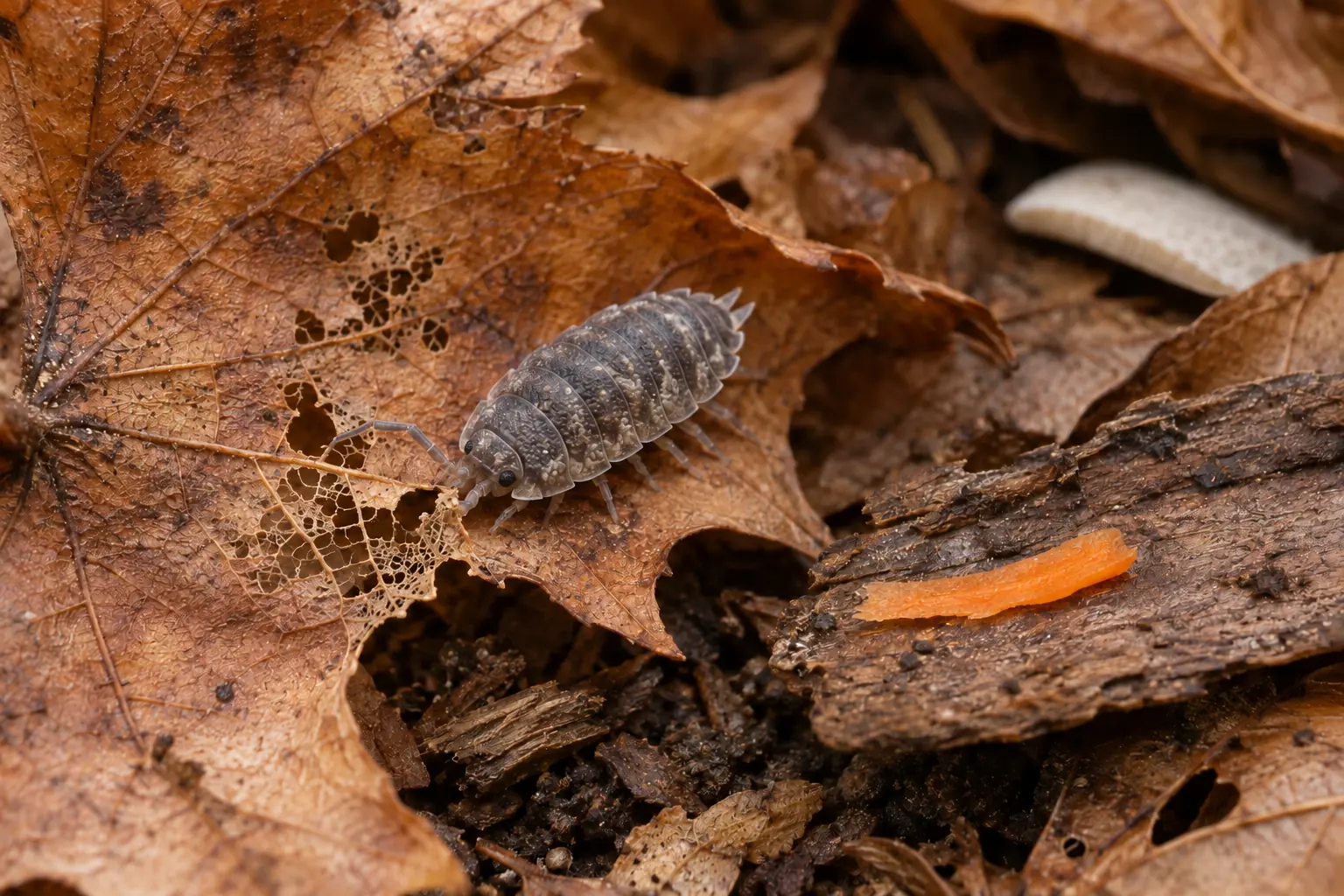
The carrot gets your attention because you put it there. The half-eaten leaf underneath it may be doing much more of the everyday work. Feeding a colony starts with noticing both meals: the food already in the habitat and the extras you bring to it.
Keep Leaves and Soft Wood Available
Terrestrial pet isopods feed on decaying organic matter. Portland Insectarium includes leaf litter and decomposing wood in its care guidance. Keep those materials available as they are used up, rather than treating every meal as something that arrives in a dish.
Choose leaves you can identify and obtain from a trustworthy, untreated source. Naturally fallen maple or oak leaves are options used by experienced keepers. Buying leaf litter intended for isopod care can be simpler if you cannot establish what has been sprayed around a collection site.
Leaf texture matters. Breeder Smug Bug reports good results with thinner leaves such as maple and elm, while tougher oak leaves take longer to disappear. Its colonies showed less interest in thick magnolia leaves. Those are keeper observations, not a promise that every species will rank every leaf the same way.
For a first colony, include suitable softer leaves instead of relying entirely on a few tough decorative ones. Replenish the supply as it breaks down and is eaten. A leaf reduced to a little network of veins is useful evidence that something has been working on it.
Soft decayed wood can contribute food too. A hard cork hide serves a different purpose, so do not count it as the colony’s whole wood supply. Our isopod substrate guide explains how those materials fit into the habitat without turning feeding into another complete enclosure build.
For a planted enclosure, our guide to isopods eating plants explains how to investigate fresh damage and decide whether the animals and plants belong together.
Why an Old Leaf Can Make a Better Meal
A freshly fallen leaf can still be a tough package. As microbes work on it, they change the material the isopod encounters. That helps explain why the tired-looking leaf can attract more attention than the crisp new one.
In a 2024 review of 56 research articles, Weng Ngai Lam and colleagues found that prior microbial activity strongly increased leaf consumption by isopods and millipedes. The authors explain that microbes likely help break down plant compounds that the animals cannot digest efficiently on their own.
The practical lesson is to let suitable leaf litter function as food as it ages. It is not a reason to serve spoiled kitchen scraps or call every fuzzy patch harmless. The research concerns changes in leaf litter; a forgotten mound of fish food is a different feeding problem.
Add Small, Useful Supplements
For fresh food, start simply. Carolina Biological Supply lists raw carrot, potato and apple among suitable offerings. Aquarimax also uses small pieces of squash and zucchini. Choose a small piece you can find and remove easily, and offer one new item at a time so you can see how the colony responds.
Protein can be supplied through foods such as fish flakes or dried shrimp sold as animal food. Smug Bug describes both as options used by keepers. Read the ingredients and ask your colony’s supplier what has worked for the species; a long list of possible foods does not mean you need to buy them all.
Species can differ in their appetite for those extras. Springtails US describes Porcellio laevis as especially keen on protein. Treat that as a reason to watch the colony’s response, rather than turning it into a fixed protein percentage or a large daily serving.
Commercial isopod foods are another option. Follow their preparation and storage directions, and establish whether the product is meant as a supplement. Keep the everyday leaf supply available. A powder or pellet should not quietly become a substitute for the whole feeding habitat.
You can keep the first menu modest: suitable leaf litter and soft wood, the colony’s calcium source, and a small trial portion of a supplemental food. Add variety gradually as you learn what is eaten. A starter colony has no obligation to finish a buffet.
Keep Calcium Within Reach
Isopods use calcium in their exoskeletons, the hard outer covering of their bodies. Springtails US recommends providing a continuing calcium source. Portland Insectarium lists cuttlebone, crushed eggshell and calcium carbonate among the options.
Plain cuttlebone intended for animal care is one straightforward choice. Place an accessible piece where you can check it, and replenish it as needed. If you use a calcium powder or a prepared mix, follow relevant product and species guidance instead of guessing a dose.
Check what the substrate or food already contains before adding multiple supplements. The goal is dependable access to an appropriate source, not seeing how many calcium products will fit in the tub.
How Often to Feed Isopods
Separate replenishing the leaves from offering supplemental food. Leaves remain available and are topped up as they are consumed. Extras need closer attention because portions that outlast the colony’s appetite can spoil.
Care guides describe different routines. Carolina suggests optional additional food once a week; Aquarimax describes some protein offerings once or twice a week. Those examples come from particular care methods. They do not establish one timetable for every species, population or enclosure.
Use the colony’s response to adjust the next offering:
- Start with a small portion in a spot where you can check it.
- Look for feeding and leftovers before adding more. A piece carried under a leaf may still be in the enclosure.
- If food remains or begins to spoil, remove it and offer less next time.
- If the portion is consistently eaten promptly, increase the next offering a little rather than making a large jump.
- Keep checking the leaf supply and calcium source even when you skip an extra feeding.
An untouched carrot does not, by itself, show that the animals have stopped eating. They may be feeding on material elsewhere in the habitat. If reduced feeding comes with losses or other unusual changes, review the colony’s conditions and seek experienced help rather than piling in more food.
Make Feeding Easy to Check
Put supplemental food where you can retrieve it without digging through the colony. Smug Bug places fish flakes on the drier side to reduce molding. That is a food-placement choice; the animals still need access to their damp refuge.
Inspect leftovers regularly and remove spoiled supplemental food promptly. Carolina specifically advises removing material showing mold. Check underneath each piece for small isopods before lifting it out. If food keeps spoiling before it is eaten, reduce the amount and reconsider where you place it.
A quick note can help while you learn: what you offered, roughly how much, and what remained at the next check. This is especially useful after the colony grows or you change foods. It gives you something better than a vague memory of what worked last month.
Over time, feeding becomes a small observation habit: a leaf turning to lace, a carrot shaving getting smaller, a supplement that was clearly too generous. A routine food check becomes a closer look at the little world you are keeping.
Until next time.

Browse more guides in our Isopods category.
Sources and Further Reading
- Portland Insectarium — Isopods
- Smug Bug — The Importance of Leaves for Isopods
- Lam, Slade and Wardle — Effects of Leaf Litter Traits on Isopods and Millipedes
- Carolina Biological Supply — Terrestrial Isopods Care Guide
- Aquarimax Pets — Isopod Care
- Smug Bug — Protein Sources for Isopods
- Springtails US — Isopod Care Guides