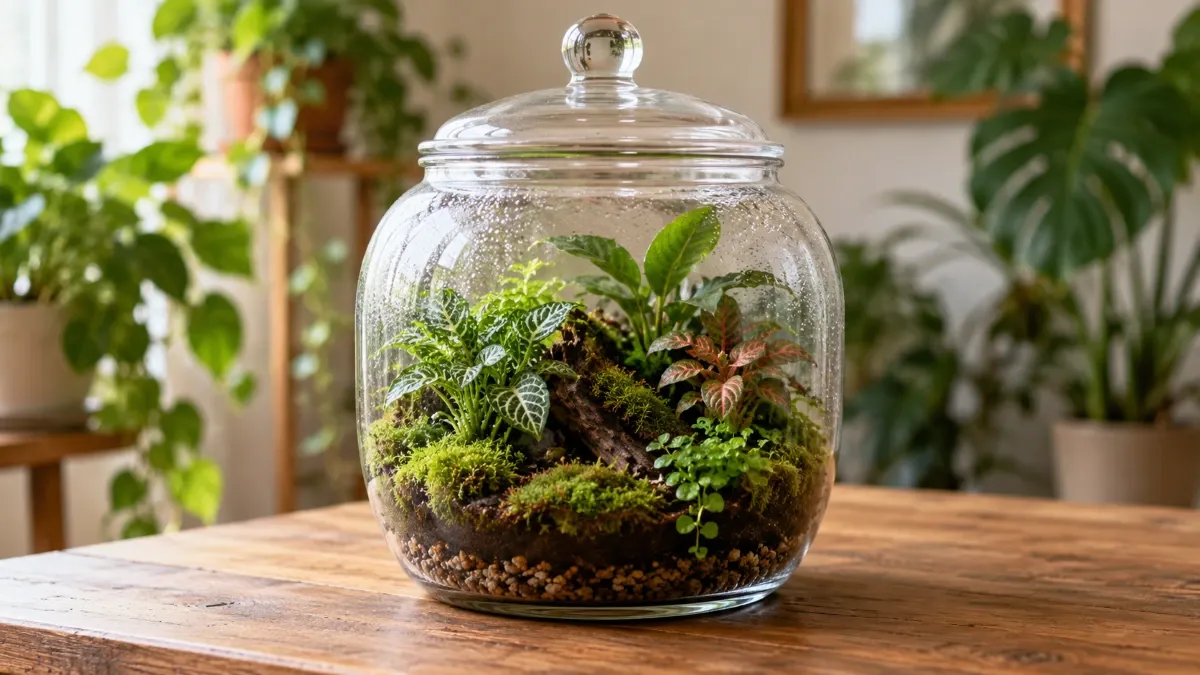
A terrarium is a small growing environment inside a clear container. In a closed terrarium, water can circulate again and again instead of quickly escaping into the room. Plants use light for energy, roots take up water and nutrients, and tiny decomposers help break down dead material.
That is the short answer to how a terrarium works: it brings several natural processes together in a small space.
Note: This guide is about planted terrariums. Animal enclosures for reptiles, amphibians, spiders, and other creatures have different requirements.
How Does a Terrarium Work?
A planted terrarium works because its parts are connected. Light reaches the plants. Plants use that light to grow. Water moves through the soil and plants, then into the air. In a closed terrarium, much of that water condenses on the glass and returns to the soil.
Meanwhile, microorganisms in the growing medium help break down dead plant material. Nutrients from that material can become available to plants again.
A healthy terrarium is more than a plant in a jar. It is a small system made up of:
- Light — the main energy source
- Plants — living producers that use light, water, and carbon dioxide
- Water — stored in the growing medium and recycled through the system
- Air — supplies carbon dioxide and oxygen
- Growing medium — supports roots and holds water and nutrients
- Decomposers — organisms that help break down dead material
The important catch is that a terrarium is not completely independent. Even a well-balanced closed terrarium still depends on an external light source. It may also need occasional pruning, cleaning, airing out, or a small amount of water.
How the Water Cycle Works Inside a Closed Terrarium
The water cycle is the easiest part of a closed terrarium to see.
1. Water enters the growing medium
When you first plant the terrarium, the growing medium contains moisture. Plant roots absorb some of that water.
2. Water moves into the air
Some moisture evaporates from the growing medium. Plants also release water vapor from their leaves through a process called transpiration.
3. Water condenses on the glass
When humid air inside the terrarium touches cooler glass, some of the water vapor becomes liquid again. This is the condensation you may see as a light mist or droplets on the inside of the container.
4. Water returns to the growing medium
Droplets can run down the glass or fall back into the terrarium. The growing medium absorbs that moisture, and the cycle begins again.
This is why a properly balanced closed terrarium can go a long time without additional watering. An open terrarium works differently because much more water escapes into the room.
What Does Light Do in a Terrarium?
Water may circulate inside a closed terrarium, but light is what powers the living system.
Plants use light during photosynthesis. In simple terms, they use light energy to make sugars from carbon dioxide and water. Those sugars provide energy and building material for plant growth.
Most planted terrariums do well in bright, indirect light. A bright room or a spot near a window works well as long as strong direct sun doesn’t heat the container.
Why direct sun can be a problem
A glass container can heat up quickly in direct sunlight, especially when it is closed. The problem is heat buildup, not a magical “magnifying glass” effect. Temperatures inside the container can rise enough to damage plants.
If natural light is poor, you can use a small LED grow light. No single distance or number of hours works for every grow light, because brightness varies widely between fixtures. Follow the light manufacturer’s guidance and watch how the plants respond.
How Plants, Soil, and Air Work Together
Plants
Plants are the most visible part of the terrarium. They use water, carbon dioxide, nutrients, and light to grow. They also release water vapor, which helps drive the water cycle inside a closed container.
Growing medium
The growing medium anchors plant roots and holds both moisture and nutrients. For most planted terrariums, the mix should stay moist enough for the chosen plants without becoming waterlogged.
Many terrariums include gravel, LECA, or another material beneath the growing medium. This lower layer can provide a place for small amounts of excess water to collect, but it does not turn a container without drainage holes into a draining pot. Too much water can still create unhealthy, soggy conditions around the roots.
Air
Plants need carbon dioxide for photosynthesis and oxygen for respiration. Plants, microorganisms, and other tiny organisms in the terrarium all affect the balance of gases inside the container.
An open terrarium exchanges air freely with the room. A closed terrarium exchanges much less air, but it is not frozen in time. Plants continue to photosynthesize and respire, and decomposers continue to break down organic material.
Why Microorganisms and Decomposers Matter
A terrarium contains life that you usually cannot see. Bacteria, fungi, and other microorganisms live in the growing medium and on organic material. They help break down dead roots, fallen leaves, and other plant debris.
That decomposition is part of nutrient cycling. Instead of dead plant material simply piling up forever, decomposers help return nutrients to the system.
What about springtails and isopods?
Some people add a small “clean-up crew” to planted or bioactive terrariums. Springtails are tiny soil-dwelling hexapods that feed on fungi and decaying material. Isopods are small crustaceans that also consume organic matter.
They are optional in a simple plant terrarium. They can be useful in the right setup, but they are not a substitute for correct moisture, suitable plants, and basic maintenance.
Open vs. Closed Terrariums
The biggest difference between open and closed terrariums is how much moisture they keep inside.
| Feature | Closed Terrarium | Open Terrarium |
|---|---|---|
| Humidity | High | Closer to room humidity |
| Water loss | Slow | Faster |
| Watering | Infrequent once balanced | Needed more often |
| Air exchange | Limited | Free airflow |
| Common plant choices | Fittonia, small ferns, mosses, some peperomias and pileas | Plants that prefer drier conditions; some succulents and cacti are used in open displays |
Closed terrariums
A closed terrarium has a lid or cover that greatly slows water loss. Humidity stays high, so it works best with small plants that prefer moist conditions.
Good candidates include many small ferns, mosses, fittonias, pileas, and peperomias. Plants in the same container should have similar moisture and light needs.
Open terrariums
An open terrarium has no lid, so moisture escapes much more easily. It needs more watering than a closed terrarium and usually stays drier.
Succulents and cacti are often used in open terrarium-style displays, but beginners should be careful: glass containers usually have no drainage hole, and these plants dislike sitting wet. A regular pot with drainage is often more forgiving.
How Can You Tell if a Terrarium Is Healthy?
You do not need special equipment to spot many terrarium problems. Look at the plants, the growing medium, and the glass.
Signs things are probably going well.
- Plants hold their color and produce normal new growth.
- The growing medium is moist but not flooded.
- A closed terrarium may show light condensation that changes during the day.
- There is little or no spreading mold.
- Leaves are not constantly pressed against wet glass.
Signs the terrarium may need an adjustment
- Constant heavy fog or large amounts of standing water: The terrarium may be too wet. Open it temporarily and allow some moisture to escape.
- Wilting in wet soil: Roots may be staying too wet, or the plant may be stressed for another reason.
- Dry growing medium and wilting plants: The terrarium may need a little water.
- Rapidly spreading mold: Remove decaying material and check for excessive moisture.
- Pale, stretched growth: The plants may need more light.
- Scorched or overheated plants: Move the terrarium away from direct sun.
The Most Common Beginner Mistake: Too Much Water
Overwatering is especially easy in a terrarium because most containers lack drainage holes. Water that goes in has nowhere to drain out.
In a closed terrarium, start conservatively. It is easier to add a little water later than to remove a large amount from the bottom of a planted container.
Do not judge moisture by condensation alone. Condensation also changes with room temperature, light, and glass temperature. Look at the growing medium and the plants too.
Does a Closed Terrarium Really Take Care of Itself?
Sometimes—mostly.
A well-designed closed terrarium can recycle much of its water and go months without much attention. But “self-sustaining” does not mean “put it on a shelf and forget it forever.”
You may eventually need to:
- Prune plants that outgrow the container
- Remove dead or diseased leaves
- Wipe the inside of the glass
- Let excess moisture escape
- Add a small amount of water if the system becomes too dry
- Adjust the amount of light
The goal is not zero maintenance. The goal is a stable little growing environment that needs much less watering than ordinary houseplants.
Frequently Asked Questions
Can a terrarium survive without sunlight?
Plants need light, but it does not have to come directly from the sun. A suitable grow light can provide the energy plants need when natural light is limited.
Should a closed terrarium always have condensation?
No. Light condensation is common, but it may appear and disappear as temperatures change. Heavy fog all day can point to excess moisture, while a completely dry terrarium combined with dry growing medium or wilting plants may need water.
Do I need charcoal in a terrarium?
Charcoal is often included in terrarium layer recipes, but it doesn’t make the water cycle work—good plant choices, careful watering, suitable light, and a clean growing medium matter more. If you use charcoal, treat it as an optional part of the setup rather than a cure for overwatering.
Do terrariums need air holes?
Not always. Closed terrariums are designed to hold humidity and have limited air exchange. Open terrariums have much more airflow. The right choice depends on the plants you are growing.
How long can a closed terrarium go without watering?
There is no fixed schedule. A balanced closed terrarium may go for months without added water. Water only when the plants and growing medium show they need more moisture.
Bottom Line
A terrarium works by combining several natural processes in a small container. Light provides energy. Plants grow and release water vapor. Moisture circulates through the growing medium, air, plants, and glass. Decomposers recycle dead material. In a closed terrarium, much of the water stays inside and is reused.
Get the light, moisture, and plant choices reasonably close, and the system can become surprisingly stable. For a beginner, the best rule is simple: give it bright indirect light, choose plants with similar needs, and resist the urge to keep adding water.
Until next time.

Sources and Further Reading
- University of Missouri Extension: Terrariums
- Penn State Extension: Creating a Closed Terrarium
- Royal Horticultural Society: Terrariums and Bottle Gardens