
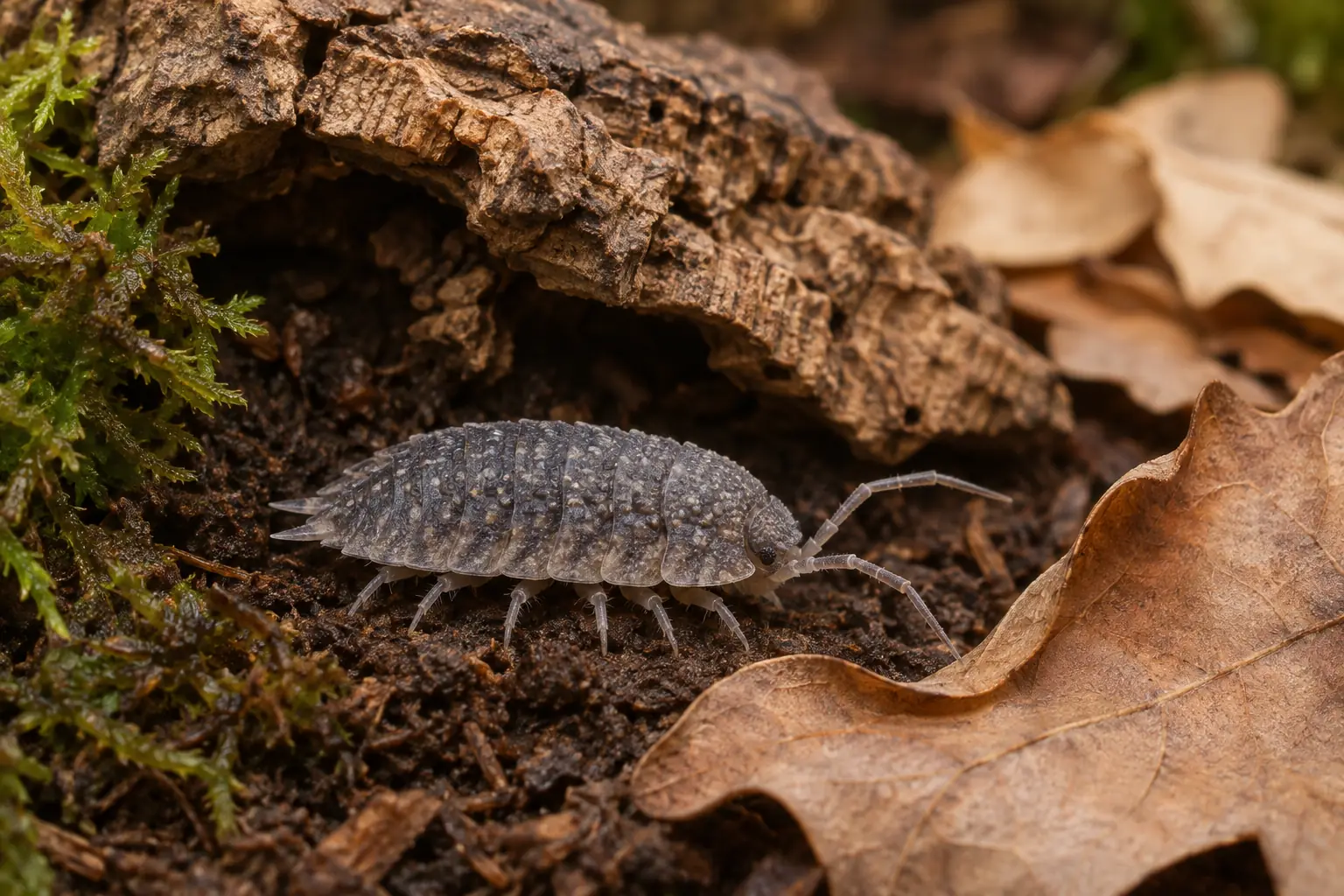
If you’re asking “why are my isopods dying?” start with moisture, temperature, and anything recently added to the enclosure. Drying, waterlogging, heat, and contaminated materials deserve attention. Check the needs of your particular species, and seek experienced help promptly if losses are continuing.
One body under a piece of bark and several deaths after a new batch of leaves are different observations. Before tearing apart the habitat, record what you actually see. The pattern will guide what you check next.
Check for an Immediate Habitat Problem
Take a quick look at the enclosure before handling animals or changing supplies. Correct a clear hazard while you investigate; you do not need to identify a disease before moving a tank out of direct sun.
- If the damp refuge has dried out, restore moisture gradually to that area. Do not flood the whole enclosure or pour water onto animals.
- If water is pooling, stop adding more. Check the substrate and existing vents while preserving a usable damp refuge.
- If sunlight or heating equipment is overheating the enclosure, remove that source of heat and check the actual temperature. Avoid sudden chilling.
- If a cleaner, spray, or treated material may have entered the habitat, stop the exposure and contact the supplier or an experienced invertebrate professional promptly.
Avoid making several unrelated changes at once. Record urgent corrections, then work through the remaining checks in order. Adding more food, water, and heat together can hide which condition was wrong.
Is the Isopod Dead, Hiding, or Keeping Still?
Isopods not moving are not automatically dead. Watch for small movements of the antennae or legs without repeatedly touching the animal. A tightly curled pill bug is also not proof of death. If you are unsure, leave it sheltered in suitable conditions while you seek advice rather than discarding it.
Do isopods play dead? Some do. In a 2015 study, Ivan Hadrián Tuf and colleagues tested this defensive stillness, called tonic immobility, in Porcellio scaber. Individuals differed in how long they stayed still, and their responses showed some consistency across repeated tests.
That finding has a practical consequence: prodding an animal again and again is a poor way to decide whether it is alive. Disturbance itself can trigger stillness. The research does not give keepers a universal waiting time, and it does not mean every motionless animal is merely defending itself.
Why are my isopods hiding? Shelter is ordinary behavior for these animals. Carolina Biological Supply notes that they avoid bright light and may be beneath the soil. Look quietly under one accessible piece of cover, then replace it carefully. Seeing fewer animals on the surface is different from finding bodies.
Once a death is clear, photograph and remove the body carefully. Record where you found it. Do not strip away the rest of the habitat to force a complete head count.
Confirm the Species and List What Changed
Find the scientific name on the original label or ask the supplier. A color-morph name alone may not tell you enough. Compare the enclosure with guidance for that species, including the conditions used by the breeder who supplied it.
Springtails US describes different moisture layouts for different species and explains that ventilation needs also depend on local climate. Its recommendations come from particular containers and cultures. Copying another keeper’s watering routine without knowing those details can miss what your animals need.
Next, write down recent changes: arrival or shipping, a room move, seasonal heating, a different lid, fresh substrate, new leaves, food, water, or cleaning products. Include the date losses began. A change is a lead to investigate, not proof that the new item caused a death.
Check Moisture Beneath the Cover
Check the substrate in the refuge, not just the humidity number above it. Smug Bug’s husbandry guide emphasizes moisture in the soil and leaf cover, where the animals spend much of their time. An air reading cannot tell you whether that protected pocket has dried out.
Gently inspect beneath an accessible edge of moss or bark, watching for animals. Compare the damp refuge with another part of the enclosure. If possible, look through the container wall for water collecting below the surface. Do not squeeze handfuls of occupied bedding.
Aquarimax recommends checking the substrate before watering and adding a little water to one side when it starts to dry. If it is already suitably damp, more water is not automatically helpful. Keep the moisture balance appropriate to the species rather than applying a fixed split to every enclosure.
When material stays saturated, check blocked vents and where water collects. Do not swing from waterlogging to drying out the entire colony. Our isopod humidity guide explains the fuller balance between moisture, cover, and airflow.
Measure Temperature Where the Enclosure Sits
Check conditions at the enclosure instead of assuming the room thermostat describes them. Note direct sunlight, nearby heaters, recent equipment changes, and differences between day and night. Compare measured temperatures with reliable guidance for your species.
Flinn Scientific’s care guide identifies extreme temperatures as a danger. Its classroom advice should not become a reason to add a heat lamp to every struggling colony. If an animal is still, warming it by guesswork is not a diagnosis or a treatment. Establish what the temperature actually is first.
Review Food and Possible Contamination
Check that suitable decaying leaves remain available, along with the normal calcium source and appropriate supplemental foods. University of California IPM describes pillbugs and sowbugs feeding mainly on decaying plant material. A vegetable snack should not be the only food you assess.
Remove spoiled supplemental food carefully, and review portions if leftovers repeatedly accumulate. Portland Insectarium includes pesticide-free food and warns against handling isopods after using hand sanitizer, scented lotions, or other chemicals. Think about what could have reached the habitat from your hands as well as from supplies.
Check labels and sourcing for new substrate, leaves, bark, and plants. Carolina cautions against chemically treated mulch. Keep any product packaging and note where collected materials came from. Do not try to neutralize an unknown exposure by adding household chemicals.
If a transfer appears necessary because the habitat is contaminated or unusable, get species-specific help with a clean replacement enclosure. Avoid moving questionable substrate into another established colony. A rushed move into unsuitable conditions can create a second problem.
Do Not Assume Every Loss Is a Molting Failure
Finding isopods dying after molting is a reason to record the timing and review conditions. It does not establish calcium shortage, dehydration, or another single cause. A nearby shed shell may belong to a different animal.
Normal isopod molting happens in two stages, so a temporary difference between the front and rear can be expected. UC IPM also shows a recently molted pillbug with bluish rear segments. Color alone cannot identify a disease or explain a death.
If an animal seems to struggle with attached covering, photograph it without handling and seek advice. Do not peel off the shell, force a bath, or bury the animal in supplements. Keep ordinary food, calcium, shelter, and suitable moisture available while you investigate.
Use the Pattern to Ask for Better Help
An isolated loss and several deaths close together deserve different levels of urgency. Do not dismiss a continuing pattern as old age, especially when you do not know the animals’ ages. Contact the supplier or a keeper experienced with the species promptly; a veterinarian who sees invertebrates may help when illness or injury is suspected.
Give them observations they can work with:
- The scientific name, when the colony arrived, and its approximate starting size.
- How many deaths you have actually found, on which dates, and whether affected animals are mostly small, large, or mixed sizes.
- Clear photographs of the animals and the whole enclosure, including vents, leaf cover, and the damp refuge.
- Temperature readings with times, where you measured, and what the substrate feels like beneath cover.
- Recent additions or care changes, possible chemical exposure, and corrections already made.
Say what you do not know. “Three bodies found since Monday after adding new leaves” is more useful than “the leaves poisoned them.” The first description preserves a clue without turning it into an unsupported conclusion.
Keep a brief record after each correction. Has the refuge stayed suitably damp? Have further deaths appeared? A quiet interval is encouraging, but it does not prove you found the cause. The aim is to give the remaining colony stable conditions while replacing guesses with observations.
Until next time.

Browse more guides in our Isopods category.
Sources and Further Reading
- Carolina Biological Supply — Care Guide: Terrestrial Isopods
- Portland Insectarium — Isopod Care
- Springtails US — Isopod Care Guides
- Smug Bug — Isopods, Humidity, and Moisture
- Aquarimax Pets — Isopod Care
- Flinn Scientific — Isopod Care Guide (PDF)
- Tuf, Drábková and Šipoš (2015) — Defensive Stillness in Porcellio scaber (Abstract)
- UC Statewide IPM Program — Pillbugs and Sowbugs