Can isopods and springtails live together? Yes—many commonly kept species can share an enclosure when their moisture and temperature needs match. Springtails are useful companions, but they are optional. Adding them does not turn an isopod colony into a self-cleaning tank.
Think of a fallen leaf on a forest floor. Several kinds of animals, fungi and other tiny organisms help break it down. Your enclosure can hold a small version of that community, with one important difference: someone still has to check the lid, water and leftovers. That someone is you.
Same Leaf Litter, Different Jobs
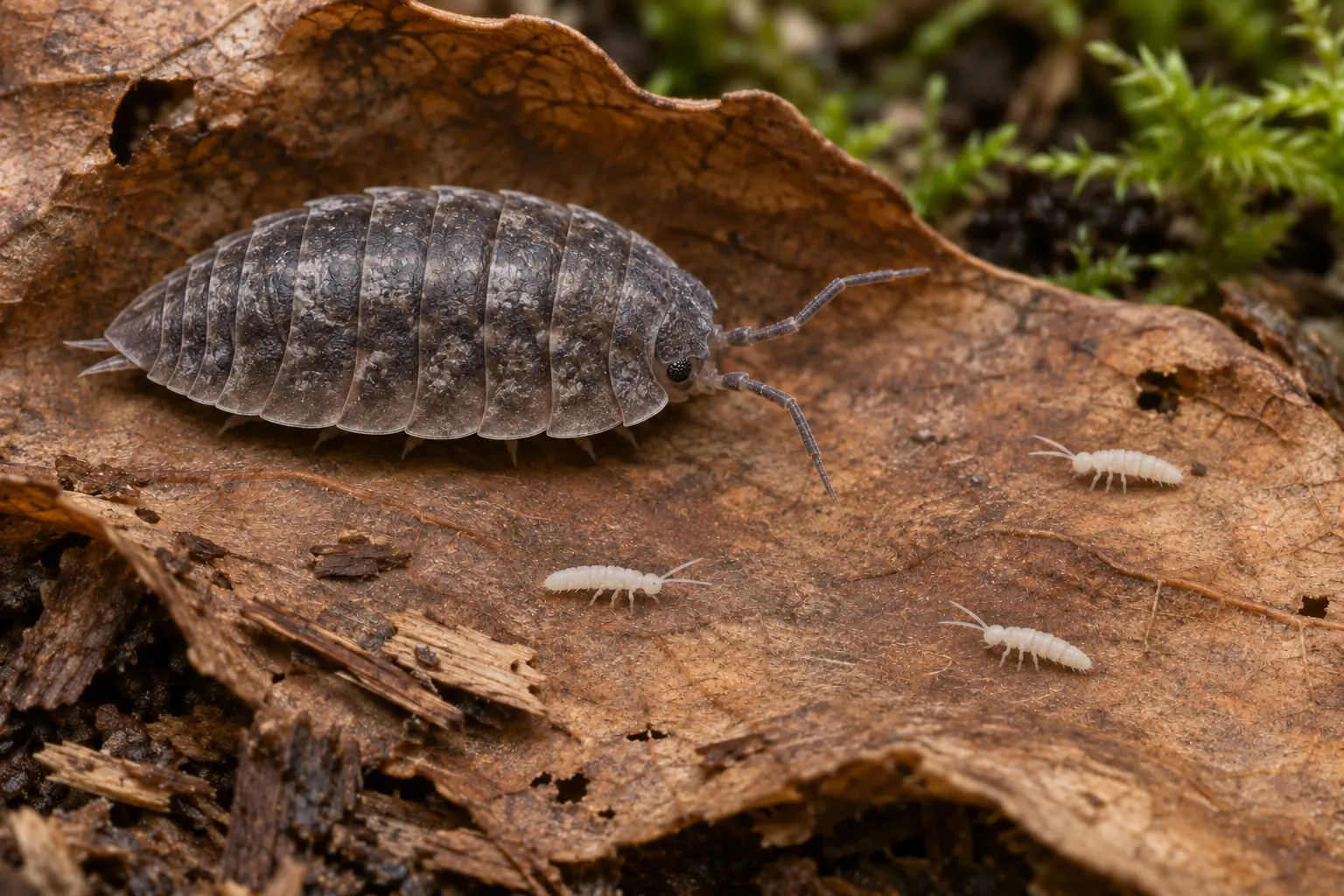
Springtails are not baby isopods. They are a separate group of tiny, six-legged animals. Adult terrestrial isopods are crustaceans with seven pairs of walking legs. The small white springtails sold for enclosures will not grow into pillbugs.
SARE’s Farming with Soil Life explains how woodlice fragment plant debris, making it easier for smaller decomposers to continue the work. Springtails feed on fungi, decaying plant material and other small food sources. Their diets overlap, so this is not a strict division where one animal handles leaves and the other handles mold.
| What you are comparing | Isopods | Springtails |
|---|---|---|
| Their contribution | Chew and fragment decaying plant material. | Graze on fungi and other small food sources; also contribute to decay. |
| What you may notice | Missing leaf edges and animals sheltering beneath bark. | Tiny moving specks around damp material; some species jump. |
| What they cannot promise | A tank that never needs attention. | An enclosure free of mold or unwanted insects. |
That springtail jump has a neat explanation. Many species carry a forked structure tucked beneath the abdomen. Releasing it launches the animal away from the surface. Some springtails have a reduced version or lack it, so jumping is a useful clue rather than a test every species must pass.
Choose a Pair, Not Just a Product Label
Ask for the springtail’s species name and care information. A container labeled cleanup crew tells you its intended job, but little about the conditions its occupants need.
Springtails US lists Folsomia candida and Pseudosinella violenta among its recommendations for isopod cultures. These are useful starting points to discuss with a breeder, not a guarantee that either suits every isopod or enclosure.
There is a worthwhile caution behind that advice. In its guide to isopod cultures, the same breeder reports using Pseudosinella violenta successfully, but warns that very large populations may stress sensitive isopods. It describes Coecobrya tenebricosa as a slower-breeding alternative. That is firsthand keeper guidance, not a controlled comparison of every possible pairing.
Before buying, explain which isopods you keep, the enclosure size, and your measured conditions. Ask whether the breeder has kept that particular combination. For an expensive or sensitive colony, specific experience is more useful than a broad claim that springtails always work.
Give Both Animals Somewhere Suitable to Live
A compatible pair needs suitable conditions at the same time. Do not make the whole enclosure wetter just because you added springtails, or remove the damp refuge because your isopods also use a drier area.
Many springtails lose water readily and depend on moist surroundings. Different species use different parts of soil and leaf litter, which helps explain why a culture suited to one setup may disappoint in another.
- Compare the recommended temperatures for both species with readings at the enclosure.
- Keep a dependable damp refuge while preserving the moisture range your isopods need.
- Provide leaf litter and sheltered spaces; do not leave the animals on a bare, exposed surface.
- Keep suitable ventilation and check beneath the cover instead of judging moisture from the lid alone.
Our isopod enclosure guide covers the container, floor and hiding places. Build that suitable home first, then choose springtails that fit it. Adding more animals will not correct a setup that is already unsuitable.
Add Springtails Without Rebuilding the Colony
You can introduce a suitable springtail culture during setup or add it to an established enclosure. Choose a sheltered, moist area and follow the supplier’s transfer instructions for the material the animals arrived on.
For example, Springtails US ships springtails on clay or paper towel and gives different handling instructions for those materials. Its clay cultures can be gently tapped out while the clay stays in the cup. That does not mean you should pour every supplier’s entire culture into the tank.
Ask the supplier for a starting amount suited to your enclosure and culture. There is no single count that guarantees success for every species and setup. Avoid repeatedly disturbing the habitat to count tiny animals. Look for activity in their sheltered area during ordinary checks.
Do Isopods Eat Springtails?
Keeping them together successfully does not prove that an individual springtail is never eaten. However, fewer visible springtails are not proof that your isopods hunted them. The sources reviewed here do not establish that predation caused a decline in an ordinary pet colony.
A 2023 study offers a useful reason to avoid blanket answers. Under simulated Antarctic conditions, Porcellio scaber reduced the abundance of one springtail species, Cryptopygus antarcticus, but did not have that effect on Folsomia candida. The experiment did not establish that the missing animals were eaten.
This was a cold-soil experiment, not a room-temperature pet-care trial. Folsomia candida also survived poorly in those cold conditions. The useful lesson is that different combinations can have different outcomes—not that the study proves a particular pairing is safe at home.
If your springtails seem to disappear, review moisture, food availability and the culture’s care needs before blaming the isopods or buying another cup. Share those details with the supplier; they give it something concrete to troubleshoot.
The Cleanup Crew Still Needs a Keeper
Springtails grazing on fungi does not mean every fuzzy food scrap should stay in the enclosure. Portland Insectarium advises removing moldy food and checking moisture regularly. Those jobs remain yours after springtails arrive.
Keep leaf litter available for the isopods and offer supplemental food in modest portions. If extras repeatedly sit uneaten, reduce those portions. Do not increase feeding simply to create a larger springtail population; more animals are not automatically evidence of a healthier enclosure.
Likewise, adding springtails is not a guaranteed fix for fungus gnats or persistent mold. Review excess food and unsuitable moisture instead of expecting a tiny animal to solve every maintenance problem. Never dry out the entire occupied enclosure to reduce springtail numbers.
The reward is more interesting than a spotless box. Watch closely and you can see different animals using the same little patch of leaf litter in different ways. Give them compatible conditions, keep up with routine care, and the cleanup crew becomes part of the pleasure of keeping isopods.
Until next time.

Browse more guides in our Isopods category.
Sources and Further Reading
- SARE — Farming with Soil Life: Woodlice
- SARE — Farming with Soil Life: Springtails
- NC State University — Collembola
- Springtails US — Isopod Care Guides
- Springtails US — Isopod Cultures
- Springtails US — Packaging and Transfer FAQ
- Portland Insectarium — Isopods
- Martin and colleagues (2023) — Isopods and Springtails Under Simulated Antarctic Conditions