
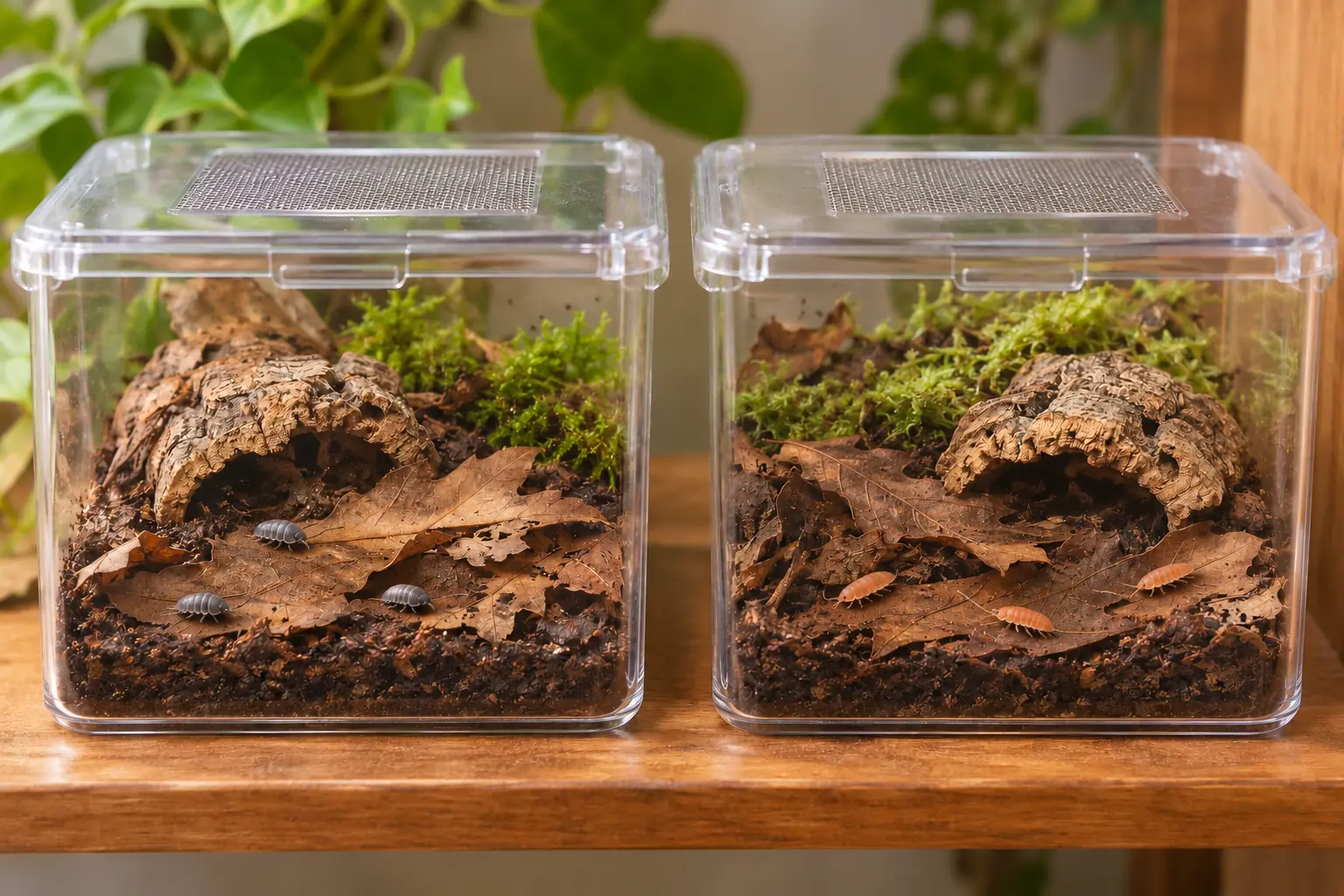
Can you mix isopod species? Sometimes, but keeping each species in its own enclosure is the simpler choice for a beginner who wants both colonies to last. Similar care needs make a shared home possible; they do not guarantee that both populations will keep doing well. Different color forms of the same species raise a separate question about breeding.
A mixed display is tempting: more colors, more shapes, fewer tubs on the shelf. The catch may take time to show up. Seeing two kinds beneath the same piece of bark today tells you where they are sitting, not whether both will still be thriving months later.
First Check What You Are Mixing
Start with the scientific names on the cultures, then ask the supplier about any unclear label. A color morph is an appearance variant within a species. A different color does not automatically mean a different species, and matching colors do not prove that two animals are the same.
| What the labels show | What that means for your decision |
|---|---|
| Two color forms of Porcellio scaber | You are considering a same-species mix. Breeding may change the color line you hoped to keep. |
| Armadillidium vulgare and Armadillidium nasatum | These are two species. Compare their care needs and monitor each population separately if combined. |
| A cup labeled only mixed isopods | Get reliable identification before deciding what conditions to provide or which colony to add them to. |
If your goal is to maintain a named color line, keep it separate from other forms of that species. Laura Mae Riepl’s Smug Bug care booklet describes how introducing a different-colored member of the same species can change the offspring produced by a color-selected culture. A mixed-color colony can be enjoyable, but it serves a different goal.
Matching Care Needs Is Only the First Check
Compare moisture, ventilation, temperature and use of the substrate for the exact animals involved. Springtails US describes different moisture layouts and ventilation arrangements for the species it breeds. Its guidance also notes that room climate changes what works. One generic isopod care label cannot settle the question.
Both species must be able to reach suitable shelter and moisture. A small damp patch is less useful if the animals crowd into it, and a larger container only helps if it provides usable habitat. More empty air above the leaves does little for an animal living underneath them.
Use our isopod care guide to review the basic needs of each colony. If meeting one species’ needs makes the enclosure unsuitable for the other, keep them apart. Do not average conflicting care instructions and hope the middle suits everyone.
Competition Can Be Quiet
Trouble does not have to look like a fight. Competition can involve access to food and suitable space, while differences in reproduction can gradually change the balance of a colony. A busy feeding spot or a tank full of babies may mainly represent one species.
Smug Bug reports a mixed culture in which dwarf white isopods, Trichorhina tomentosa, were associated with Porcellionides pruinosus becoming scarce and nearly disappearing. That is a keeper’s observation, not a controlled demonstration that every such pairing must fail or that one specific mechanism caused the decline.
Research gives a more interesting picture than a rule that one species always wins. In a 1984 study, Philip Ganter kept Armadillidium nasatum and Armadillidium vulgare under different crowding, food and species arrangements. The published abstract reports that greater crowding reduced growth and survival in both species, yet mixed-species groups improved some measured outcomes compared with single-species groups.
The study also found effects when food was abundant. It is a useful reminder that adding food does not solve every crowding problem—and that competition among members of the same species matters, too. Those particular results are not a compatibility guarantee for every home enclosure.
Look for each population continuing over time. Can you still find both species during normal checks? Can you identify young from both? If you cannot reliably tell them apart, you also cannot confidently say that both are breeding successfully.
Can Isopods Crossbreed?
Different color morphs of the same species can breed with one another. Their young will not necessarily preserve the appearance or proportions you started with. Keeping the original cultures separate is easier than trying to restore a particular color line after mixing.
Mixing separate species is not a dependable way to create new hybrid colors. Be careful with sweeping claims about all isopods, though. A study published in Current Zoology documented hybridization between Porcellio dilatatus dilatatus and Porcellio dilatatus petiti. Those are subspecies within Porcellio dilatatus, not two unrelated pet species.
That distinction matters when someone shares a claim about an isopod hybrid. Ask which scientific names were involved and what evidence supports it. An unusual-looking youngster alone does not establish a cross between species. For the ordinary keeper, preserving a known line is a much clearer goal than hoping two different species will produce a surprise.
Make a Plan Before Combining Colonies
If you are experienced and still want a mixed display, decide how you will judge success and how you would separate the animals. Keeping established backup colonies of each species gives you options if the display becomes unbalanced. That means mixing may not actually save shelf space.
- Record the species, source and date of each addition. Keep labels with the individual backup colonies.
- Check each species during routine care, rather than judging success from the total number of animals visible.
- Have suitable separate housing ready before one population becomes difficult to find.
- Avoid moving used substrate, occupied bark or leaf litter between cultures you intend to keep separate; small hitchhikers are easy to miss.
Careful observation is useful, but repeated digging to conduct a census is disruptive. A brief note about where you saw each species, signs of young, and any losses is more practical than trying to count every hidden animal.
What If They Are Already Mixed?
An existing mix is not automatically an emergency. Identify the animals and review the conditions first. If your goal is to preserve separate colonies, prepare their new homes before moving identifiable individuals gently. Avoid dumping shared substrate into the new cultures if you want to keep them separate.
Check transferred leaves and hides for smaller animals. Treat the original enclosure as mixed even after removing the adults you can see; youngsters may remain hidden. If identification is uncertain, ask an experienced keeper for help and describe the colony honestly if you rehome animals.
If one population seems to be declining, review moisture, temperature, food and recent changes while arranging suitable separate housing. Do not assume competition is the only possible cause. Portland Insectarium’s care advice still applies: monitor moisture, remove spoiled food and adjust housing as populations grow.
Separate colonies can be just as interesting to watch. You can notice which animals spend more time under bark, how their feeding marks differ, and where the youngsters gather. Each small world becomes easier to understand when you know who lives there.
Until next time.

Browse more guides in our Isopods category.
Sources and Further Reading
- Smug Bug — Cohabbing Isopods
- Laura Mae Riepl / Smug Bug — Isopods: Basics of Care
- Springtails US — Isopod Care Guides
- Philip F. Ganter (1984) — The Effects of Crowding on Terrestrial Isopods (abstract)
- Bech and colleagues (2021) — Experimental Evidence of Wolbachia Introgressive Acquisition Between Terrestrial Isopod Subspecies
- Portland Insectarium — Isopods