
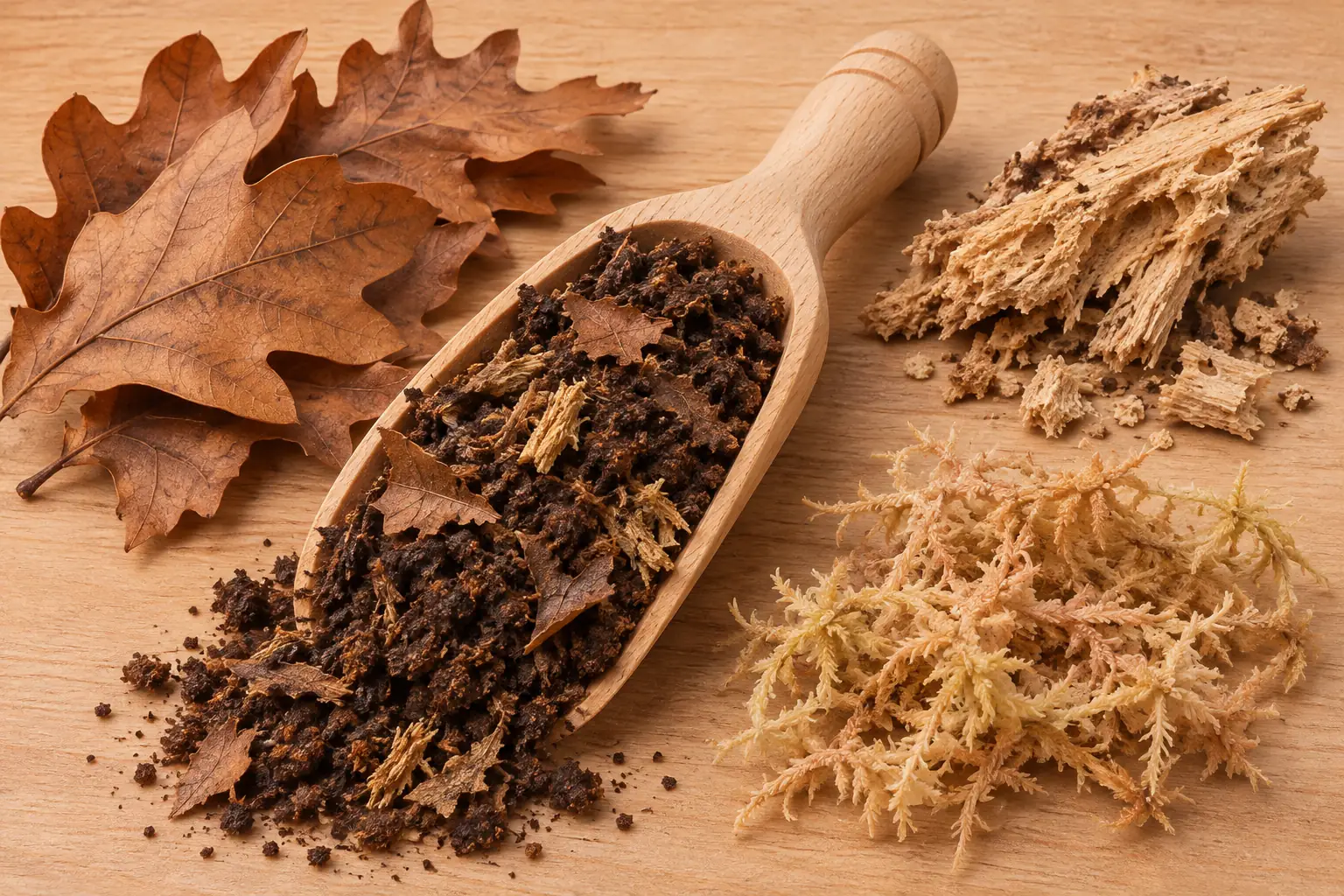
Good isopod substrate holds moisture, gives the animals places to shelter or burrow, and includes organic material they can feed on. Common mixes combine a suitable soil or compost base with leaf material and wood, while moss can help hold moisture. Choose ingredients for the species you keep and the job each material does.
For an isopod, the floor is also part of the pantry. That makes choosing bedding a little different from picking something that looks tidy in a tank. A brown material can fill the bottom beautifully and still leave the colony short of useful food or cover.
What the Substrate Needs to Do
Think about three jobs: holding moisture, providing living space, and supplying edible organic matter. One ingredient may help with more than one job, but that does not make it a complete habitat by itself.
SARE’s woodlice profile describes animals living beneath bark and logs, in damp leaf litter, and in the upper soil. They feed on soft or decayed plant material and break it into smaller pieces. The useful model is a working patch of woodland floor, with sheltered spaces and material in different stages of breakdown.
In a container, that floor should be manageable too. You need to check its condition beneath the surface. A dry-looking top does not tell you whether the material below is damp, and a wet top does not prove the whole depth is suitably moistened.
What Common Ingredients Contribute
These are ingredient roles, not a recipe with equal portions. Portland Insectarium and experienced breeders use combinations of these materials, but their mixes differ.
| Material | Useful role and main limitation |
|---|---|
| Suitable soil or compost base | Provides the main body of the mix. Check its ingredients and source; the word soil does not describe one standard product. |
| Fallen leaf material | Supplies food and cover. Some can be mixed through the substrate, with a loose layer kept on top. |
| Soft decayed hardwood | Adds organic material the colony can use. A hard bark hide is not the same thing as crumbly wood incorporated into a mix. |
| Sphagnum moss | Helps retain moisture. It can be mixed in or used in a damp refuge, but does not replace the other components. |
| Calcium source | Supports the animals’ calcium needs. Cuttlebone or another suitable source can be supplied separately; it is not the bulk bedding. |
Do not mistake every wood product for the same ingredient. Decayed hardwood, bark, fresh shavings, and manufactured pellets differ. Ask what a recommended product actually contains and how it is meant to be used. Carolina Biological Supply advises against pine bark and chemically treated mulch in its isopod habitat guidance.
Extra ingredients are not automatically upgrades. For example, perlite may appear in a potting mix, but it contributes no food. Smug Bug does not treat its presence as an automatic reason to reject a mix. Assess the whole product instead of sorting ingredients into good or bad based only on their names.
Can Isopods Live in Coco Coir
Coco coir can be an ingredient in an isopod setup, but plain coir should not be treated as a complete food-and-bedding system. Aquarimax reports keeping isopods successfully with coir-based substrates while adding other ingredients, and later moving to different mixes. Smug Bug also allows coir as an additive while advising against using it alone.
The useful distinction is moisture versus nutrition. Coir can help with the physical structure of a mix without replacing the leaf litter and other food material your colony needs.
Coir products also vary. Utah State University Extension explains that finer coir particles hold more water than coarser material. That is research about a material’s properties, not proof that a particular garden product is suitable for isopods.
If a proposed mix is mostly coconut material, ask what supplies the food, what type of coir is included, and how it behaves when damp. A brick that expands into a large pile has solved a volume problem. It has not necessarily solved the colony’s other needs.
Why Leaf Litter Belongs on Top Too
Crushed leaves mixed into bedding and whole leaves on the surface do related but different jobs. The mixed material spreads organic matter through the substrate. The surface layer creates cover and a place to feed. Do not assume that a few visible leaf fragments in a bag replace that loose covering.
Isopod leaf litter also changes as it ages. In a 2024 review of laboratory studies, researchers found that prior microbial activity on leaves generally increased how much isopods and millipedes consumed. Bacteria and fungi can help turn fallen material into a more usable food resource.
That does not mean every moldy item is suitable, or that all leaves are interchangeable. The researchers also found differences among the animals and plant materials studied. For this substrate decision, the lesson is simple: the condition of organic material matters as well as its name.
Choose a Mix You Can Understand
A ready-made isopod substrate can save you the work of gathering ingredients. A homemade mix gives you control over what goes in. Either choice is easier to judge when you know the contents and have guidance for your species.
Before buying or mixing, work through these questions:
- What forms the base, and what provides edible leaf or wood material?
- Does the mix already contain calcium, and what separate source does the keeper recommend?
- Are any fertilizers, pesticides, or other treatments listed? If something is unclear, can the supplier explain it?
- Has the mix been used with the species you plan to keep, and under what conditions?
- Does the seller explain whether to use it directly, moisten it, or combine it with other materials?
A label such as natural, organic, or bioactive is not an ingredient list. For a first colony, choose a product with clear contents and relevant husbandry guidance. Avoid added plant-food formulations and materials with an unknown treatment history; you do not need to experiment with a mystery bag.
Apply the same care to collected soil, leaves, and wood. Know what the material is and whether the collection area has been treated. Washing or heating it is not proof that chemical contamination has been removed. If you cannot establish a trustworthy source, choose another one.
Check the Material Before Adding Animals
Prepare the mix according to its instructions. If it is dry, add water gradually and mix it through so you can judge the texture. Aquarimax describes suitable prepared substrate as moist rather than soaked; water squeezing out of it is a sign that it is too wet for that method.
Look for material you can gently loosen and work with, rather than a hard, compacted mass or a bowl of mud. This is a practical inspection, not a test that proves a mix is safe. The source and ingredients still matter.
The depth and damp-to-drier balance need to suit the species. Do not press the whole mix into a solid block just to make the surface look level. Keep leaf cover available and leave yourself access to inspect the material underneath.
Once you have chosen the substrate, use our guide to set up an isopod enclosure to arrange the floor, hides, ventilation, and damp refuge. The mix and the enclosure need to work together.
You do not need the longest ingredient list on the shelf. You need to understand what your chosen materials provide and what still needs to be supplied. That turns a bag of brown stuff into a habitat you can make sensible decisions about.
Until next time.

Browse more guides in our Isopods category.
Sources and Further Reading
- Portland Insectarium — Isopods
- Smug Bug — Substrate for Isopods
- Aquarimax Pets — Isopod Care
- SARE — Farming with Soil Life: Woodlice
- Lam, Slade and Wardle — Effects of Leaf Litter Traits on Isopods and Millipedes
- Utah State University Extension — Soil Water-Holding Materials, Including Coir
- Carolina Biological Supply — Terrestrial Isopods Care Guide